Kill the Content Calendar: Running a Real-Time Social Desk With AI
The monthly content calendar is built for an internet that no longer exists. Here's how to run a real-time social desk with AI without going off-brand.
By Dylan Morrow
 Journalsocial
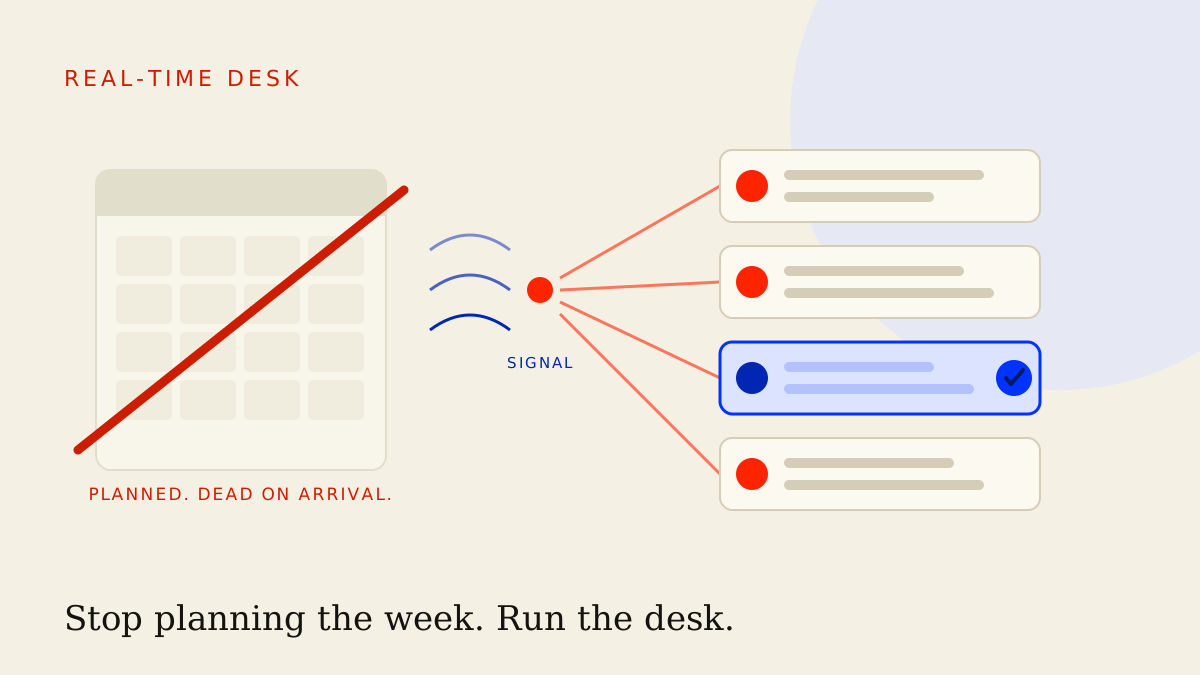
You watched it happen again last week. A moment broke on a Tuesday, the whole timeline was talking about it by lunchtime, and your brand's response went live the following Monday — polished, approved, and six days too late to matter. Meanwhile the calendar you planned in a workshop a month ago kept dutifully shipping posts about a campaign nobody remembered launching.
The monthly content calendar was built for a slow internet that no longer exists. Modern social isn't a publishing schedule — it's a desk, and the desk is always on. Here's how to run one with AI without trading speed for brand safety.
TL;DR
- The frozen calendar fails because it's a prediction, not a plan. You commit to posts weeks before you know what the week will actually be about. Half of them land dead on arrival.
- Social is now a newsroom, not a magazine. The winning model is an always-on desk that monitors signal, reacts fast, and stays on-brand — not a grid filled in once a month.
- AI is what makes a real-time desk possible for a lean team. Signal monitoring, fast on-brand drafting, and instant repurposing collapse a newsroom's headcount into a workflow.
- The answer is hybrid, not chaos. Run an evergreen baseline of planned content with a reactive layer on top. Structure for the predictable, speed for the moment.
- Guardrails are what let you move fast. Defined beats, hard lines, and a QA gate scaled to risk mean real-time never means off-brand or off the rails.
Why the calendar fails
The content calendar makes one fatal assumption: that you can know in week one what your audience will care about in week six. You can't. Nobody can.
So you fill the grid with the only things you can predict — product beats, awareness days, the campaign you're contractually obligated to push — and ship them on schedule whether or not the room has moved on. The calendar optimises for being finished, not for being relevant. A full grid feels like control. It's a commitment you made before you had the information.
Three failure modes show up every single time:
- Planned too early, dead on arrival. The post that looked sharp in the workshop reads as tone-deaf the day it goes out, because the context around it changed and the post didn't.
- Missing the moment entirely. The thing your audience is actually talking about isn't on the grid, so it doesn't get made — or it gets made so slowly the moment's gone.
- Approval lag baked in. A rigid calendar trains a rigid approval chain. By the time a reactive idea claws its way through a process designed for planned content, the window has closed.
This is brutal everywhere, and it's worse in fast cycles. In Web3 and crypto, the narrative can flip twice before lunch — a calendar planned on Monday is a museum piece by Wednesday. If your category has a news cycle, the calendar isn't protecting you. It's anchoring you to a week that already ended.
The newsroom model
Stop thinking like a magazine and start thinking like a newsroom. A magazine plans an issue, prints it, and ships it on a fixed date. A newsroom runs a desk — always staffed, always watching, ready to react to whatever breaks while still filing the planned stories.
The shift is from publishing on a schedule to responding to the world in real time. Three things define the desk:
It's always on
Somebody — or something — is always watching the channels that matter to your brand: the platforms, the competitors, the cultural beats, the specific conversations your audience lives in. Signal doesn't wait for your planning cycle, so neither can your attention.
It runs on beats
A good desk doesn't react to everything — it reacts within defined beats. A beat is a lane you've decided your brand has standing to play in: your category, your point of view, the kinds of cultural moments that genuinely connect to what you do. Beats are how a newsroom stays focused instead of chasing every shiny object. They're also your first guardrail — if a moment doesn't touch a beat, you don't play it.
It has a rapid-response path
When something breaks inside a beat, there's a fast lane from spotted to shipped. Not the six-day approval marathon — a compressed loop with the right people and a sign-off rule that matches the risk. The whole point of the desk is that the time from signal to post is measured in hours, not weeks.
The reason brands didn't all run newsrooms before is obvious: monitoring, writing, and editing at speed used to need real headcount. That's the part that's changed.
How AI makes the desk possible for a lean team
A real-time desk used to be a luxury for brands with a war room and a night shift. AI collapses that into a workflow a small team can actually run. Four jobs, each one accelerated:
1. Signal monitoring. AI watches the firehose so you don't have to. It can summarise what's moving across your beats, cluster the noise into a handful of real signals, and surface the ones worth a human look — turning an impossible monitoring job into a short briefing you read with coffee.
2. Fast on-brand drafting. This is where the desk lives or dies. The instant a signal clears the relevance test, AI drafts platform-native posts in your voice — not one generic caption, but a thread, a short-form hook, and a community post, each built for its channel. The bottleneck was never ideas; it was the forty minutes it took to write three good native variants. AI takes that to forty seconds.
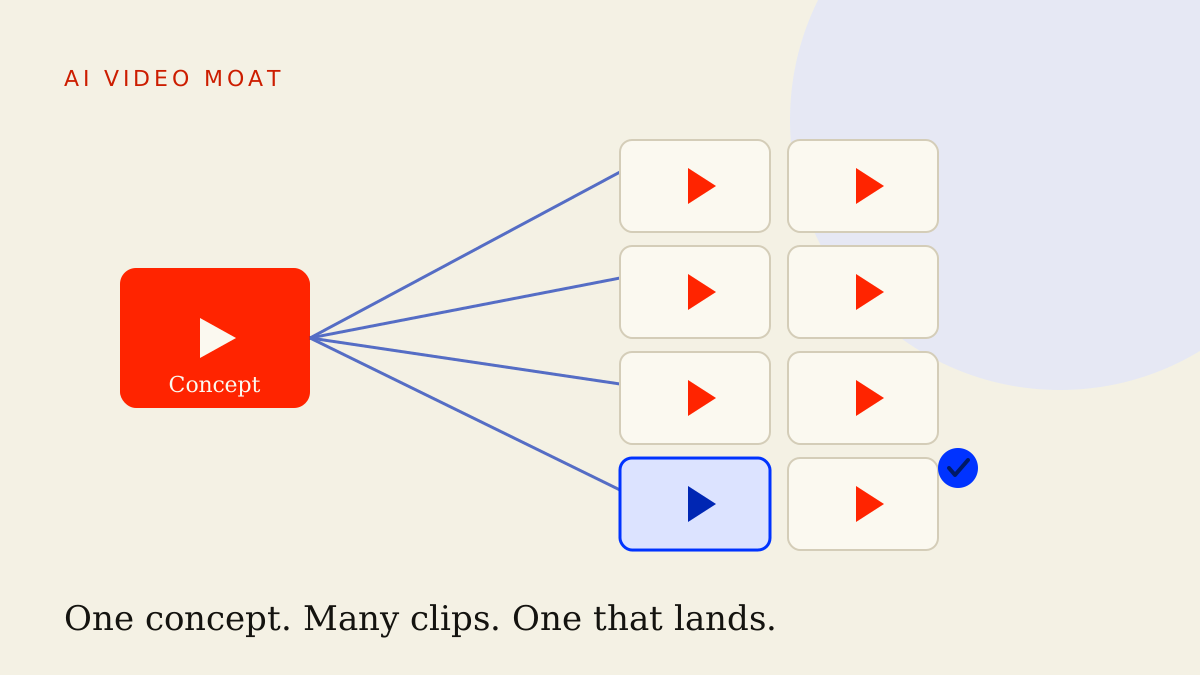
3. Repurposing on the fly. A single reactive moment should fan out across every channel where it's relevant, immediately. AI handles that transformation natively, which is the content repurposing system running at the speed of the news cycle instead of the speed of your week.
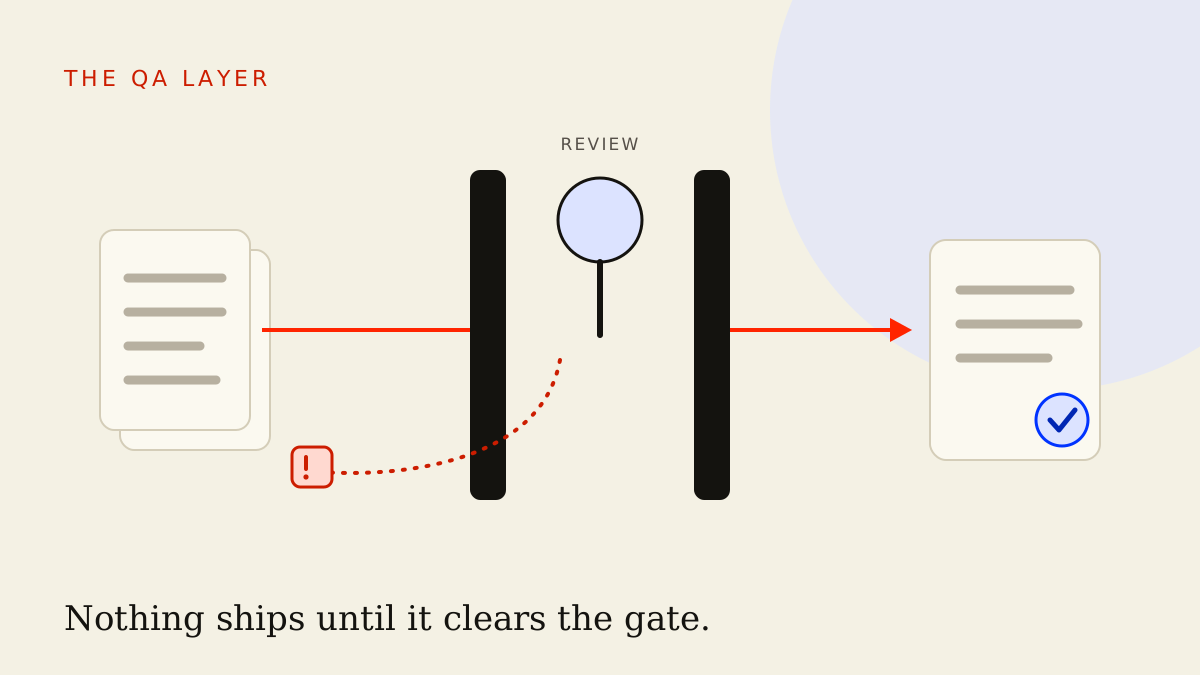
4. A QA gate so speed doesn't break brand. Fast drafting without a check is how you ship the post you regret. The desk runs every reactive draft through a fast gate — voice match, factual accuracy, brand-line check — before a human gives it the final yes. The same gate is what makes the output measurable, which is how you prove the desk's ROI instead of just claiming it.
Here's the core drafting prompt — the one that turns a raw signal into ready-to-ship, platform-native posts in seconds:
You are my brand's real-time social desk writer. A signal just broke.
Use the VOICE PROFILE and BEAT RULES below for everything.

SIGNAL: [paste the trend / news / cultural moment in 1–2 sentences]
OUR ANGLE: [one line — the specific point of view we're adding]

First, run the relevance test and answer in one line each:
- Which BEAT does this touch? (if none, stop and say "PASS — off-beat")
- What's our genuine point of view? (if we're just chasing, say "PASS — no POV")
- Brand risk: LOW / MEDIUM / HIGH, with one sentence why.

If it passes, produce platform-native posts — REBUILD per channel, do not resize:
1. X/thread — hook-first, one idea per line, our voice, no "thread:".
2. Short-form video hook + 3-beat script — spoken rhythm, 2-second open.
3. LinkedIn — a stance with white space, one line that invites a reply.
4. Community/Discord message — first-person, written to people, not at them.

End with a QA FLAGS section: anything unverified, any line that brushes a
brand hard-line, and a one-word verdict — SHIP, EDIT, or HOLD-FOR-HUMAN.

VOICE PROFILE:
[paste profile]

BEAT RULES + HARD LINES:
[paste beats you play in + lines you never cross]
That single call is the desk in miniature: it tests the signal, drafts native variants, and flags its own risk — leaving the human to do the one thing AI shouldn't, which is decide.
The hybrid: evergreen baseline + reactive layer
Killing the calendar does not mean posting into the void on vibes. The opposite of a frozen grid isn't chaos — it's a baseline plus a layer.
The evergreen baseline is everything you can genuinely plan: your always-true brand stories, educational content, product beats, the series you run on a cadence. This is your floor. It ships regardless of what's happening in the world, and it means a quiet news week never leaves your channels empty. Plan it like you'd plan anything — it's the predictable part, so treat it predictably.
The reactive layer sits on top, and it's deliberately unplanned. You don't fill it in advance; you leave room for it. When a signal breaks inside a beat, the reactive layer is where it lands — fast, native, on the day. The baseline keeps the lights on; the reactive layer is where you win the moment.
A practical split is to plan roughly 60–70% of your output as baseline and hold 30–40% open for reaction. The exact ratio depends on your category — a brand in a brutal cycle holds more open; a slower B2B brand holds less. The point isn't the number. The point is that you stop pretending the whole week is knowable and you reserve real capacity for the part that isn't.
Guardrails so real-time doesn't mean reckless
Speed is only an asset if it doesn't ship something you have to delete and apologise for. The guardrails are not bureaucracy — they're what permit the speed, because everyone knows the boundaries in advance and doesn't have to relitigate them in the moment.
- Beats define what you're allowed to play. If a moment doesn't touch a defined beat, the answer is no. Most viral moments are not yours, and the discipline to pass is half the job.
- Hard lines define what you never touch. Tragedy, politics you have no standing in, anything that needs a lawyer, anything that punches down. Write these down once. They are non-negotiable and they make the fast decisions easy.
- A sign-off rule scaled to risk. Low-risk, on-beat, on-voice posts can ship on one person's yes. Medium and high risk escalate. The cost of being wrong sets the height of the gate — that's how you keep the fast lane fast without leaving it ungoverned.
- A voice the AI actually respects. None of this works if the drafts sound like a generic brand bot. A real brand voice profile is what lets you generate at speed and still sound unmistakably like you.
The honest nuance: a real-time desk has more discipline than a calendar, not less. It just front-loads the discipline into rails instead of back-loading it into a slow approval chain.
Roles and cadence
You don't need a newsroom's headcount. You need the newsroom's roles, most of which AI now assists. On a lean team one person often wears several hats:
- Monitor. Reads the AI-summarised signal briefing, decides what's worth a human look. This is a 15-minute job twice a day, not a full-time stare at the timeline.
- Desk writer. Takes a greenlit signal, runs the drafting prompt, shapes the native variants. AI does the volume; the human does the taste.
- Editor / gatekeeper. Owns the QA gate and the sign-off rule. The last human eyes before ship. On high-risk moments, this is the most important seat at the desk.
A workable daily cadence: a morning signal sweep (what broke overnight, what's moving, what's on-beat), live reaction through the day as things break, and an end-of-day check on what shipped and what the baseline needs tomorrow. The baseline gets planned weekly like normal; the reactive layer gets run daily.
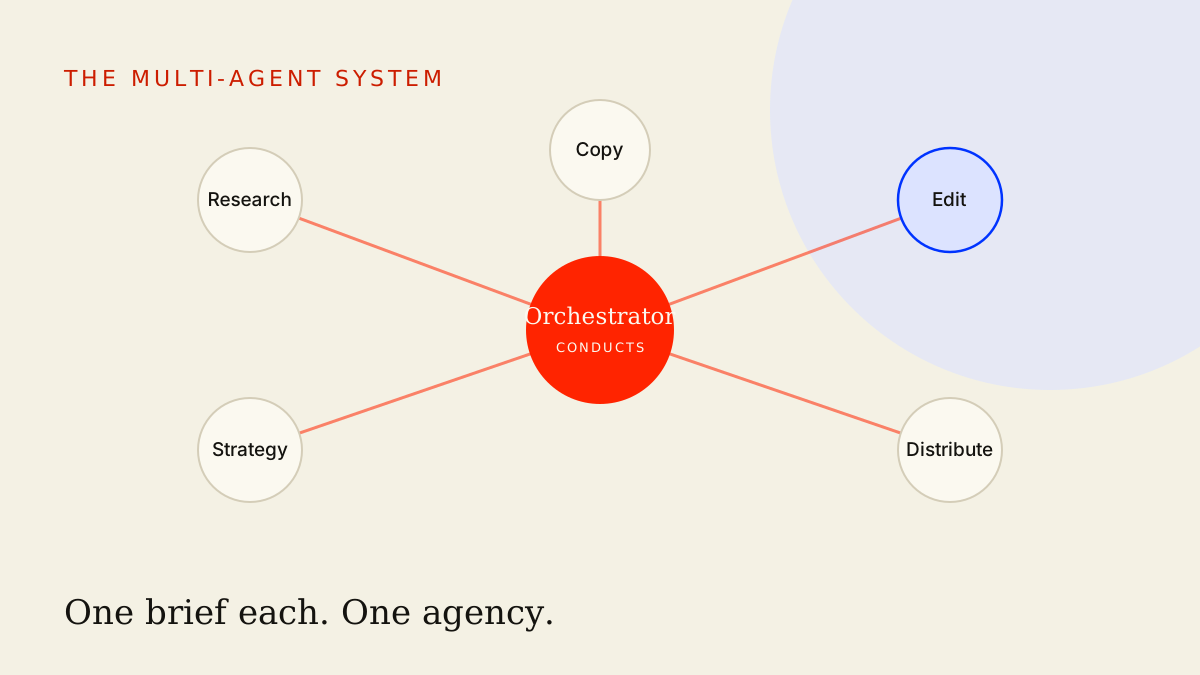
This is the same operating logic as the broader orchestration playbook — AI does the volume and the velocity, humans own the judgement and the risk. The desk is just that principle pointed at the one part of marketing where being a week late means being invisible.
Key takeaways
- The frozen calendar fails because it commits you to predictions you make before you have the information. Relevance dies on the grid.
- Run a newsroom, not a magazine — an always-on desk that monitors signal, reacts within defined beats, and ships in hours.
- AI is what makes the desk possible for a lean team: signal monitoring, fast on-brand drafting, instant repurposing, and a QA gate, collapsed into a workflow.
- Hybrid beats chaos. A planned evergreen baseline keeps the lights on; a reserved reactive layer wins the moment. Hold 30–40% of capacity open.
- Guardrails are the enabler, not the brake. Beats, hard lines, and risk-scaled sign-off are what let you move fast without going off-brand.
The calendar isn't your safety net — it's your anchor, and it's holding you a week behind the conversation every time. Build the desk instead: a planned baseline, a reserved reactive layer, AI on the volume, and a human on the judgement. Start by writing the brand voice profile your drafts will run on, wire it into your first AI workflow, and run the whole thing on the logic of the orchestration playbook.
Frequently asked
- Should I scrap my content calendar completely?
- No — you scrap the frozen monthly grid, not all structure. Keep a planned evergreen baseline of content you know you'll publish regardless of the news cycle, and run a reactive layer on top of it. The mistake is treating a calendar drawn six weeks ago as a contract instead of a hypothesis. Plan the baseline; leave room for the moment.
- Won't a real-time desk just produce reckless, off-brand posts?
- Only if you run it without guardrails. A real-time desk is fast generation plus a QA gate, not a licence to post whatever's trending. You define beats you're allowed to play in, lines you never cross, and a sign-off rule scaled to risk — then AI drafts inside those rails. Speed and safety aren't opposites here; the rails are what let you move fast without flinching.
- Can a small team actually run a newsroom model?
- Yes, and AI is the reason it's now possible. The old newsroom needed monitors, writers, and editors as separate headcount. A lean team uses AI for signal monitoring and first-draft generation, then spends its scarce human hours on judgement: which signals to play, and whether a draft is safe to ship. Two people with good rails beat a ten-person team with no system.
- How do I know which trends or signals are worth reacting to?
- Run every signal through a fast relevance test before you draft: does it touch one of your defined beats, can you add a genuine point of view, and is the brand risk acceptable? If it fails any of the three, you skip it. Most viral moments are not yours to play, and the discipline to pass is as important as the speed to react.
This is the thinking. The systems are the proof.
See how these ideas ship as working infrastructure.