How to Build a Brand Voice AI Will Actually Respect
Generic AI output is a voice problem, not a model problem. A step-by-step guide to building a brand-voice system Claude and ChatGPT follow every time.
By Dylan Morrow
 Journalbrand voice
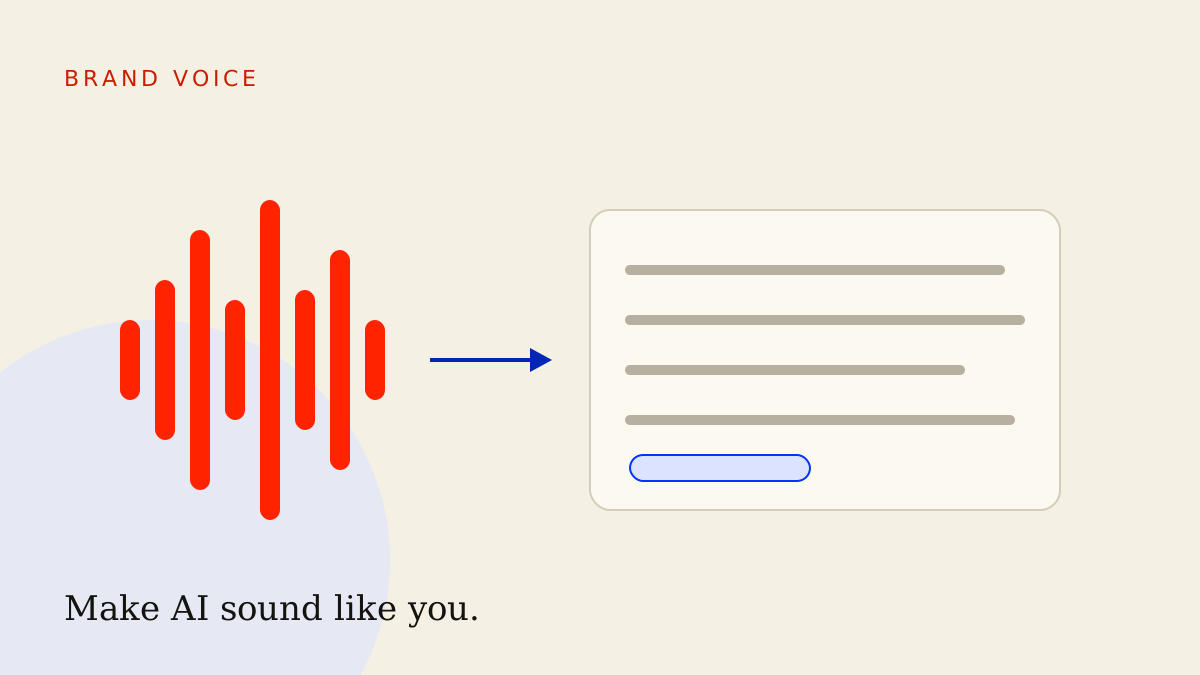
Your AI writes like a press release wrote a LinkedIn post. Bland, hedged, allergic to a strong opinion. Most people blame the model and go shopping for a better one. They are solving the wrong problem.
Generic output is a voice and context problem. The model already knows how to write like you. It just has no idea who "you" is until you tell it.
TL;DR
- Generic AI output is a context problem, not a model problem. Fix the input, not the tool.
- Extract your voice from your best content instead of inventing adjectives from scratch.
- Build a one-page voice guide plus a do/don't word list the model can actually act on.
- Load it as persistent context (a Project, Custom GPT, or custom instructions) so you stop re-pasting it.
- Test and enforce it with a voice-audit pass and a reusable "write in our voice" prompt.
Why your AI sounds like everyone else's
Out of the box, Claude and ChatGPT write to the safe average of the internet. That average is hedged, polite, and forgettable, because it is optimized to offend no one.
Your brand is not the average. It has opinions, rhythm, words it loves and words it bans.
When you give the model none of that, it fills the gap with the average. The blandness is not the ceiling of the model. It is the absence of your input. Close that gap and the same model produces copy your audience recognizes as yours.
Step 1: Extract your voice from what already works
Do not start by brainstorming adjectives. "We're bold, authentic, and approachable" is what every brand deck says and it tells the model nothing.
Start from evidence. Pull 3 to 5 of your best pieces — the tweet that popped, the newsletter people replied to, the landing page that converted. Then make the AI do the analysis.
You are a brand voice analyst. Below are 3-5 pieces of our best-performing
content. Ignore the topics. Study only HOW it is written.

Extract:
1. Tone traits (5-7 adjectives) with a one-line justification + quoted example for each.
2. Sentence rhythm: typical length, short/long mix, fragments allowed?
3. Vocabulary signatures: words/phrases we reach for, and the register
   (casual, technical, degen, formal).
4. Point of view: do we use "we", "you", "I"? How direct are our opinions?
5. Formatting habits: emoji, lists, line breaks, em-dashes, all-caps.
6. Three things we clearly AVOID.

Output as a tight bulleted profile. Quote our actual text as proof for every claim.

CONTENT:
[paste 3-5 pieces here]
This grounds your voice in real patterns, not vibes. The quoted-proof requirement matters — it forces the model to point at evidence instead of flattering you.
Step 2: Compress it into a one-page voice guide
A 12-page brand bible is useless to an AI and to you. The model needs something short enough to hold in working memory on every request.
Take the audit output and squeeze it into one page with these sections:
- One-sentence voice statement — "We sound like a sharp friend in the space who has done the homework, not a fund's IR department."
- 5-7 tone traits, each with a do/don't pair.
- Point of view rules — pronouns, how strong opinions get, what we never hedge on.
- Formatting defaults — sentence length, lists, emoji policy, em-dash rules.
- Three hard bans — the moves that instantly read as off-brand.
Keep it under ~400 words. If a rule is not specific enough to act on, cut it or sharpen it.
Add a do/don't word list
This is the highest-leverage page in the whole system. Models latch onto concrete words far better than abstract traits.
Build two columns:
- Use: the verbs, nouns, and phrases that sound like you (e.g. "ship," "onchain," "the play here," "let's be real").
- Avoid: the corporate filler and clichés that kill your voice (e.g. "leverage synergies," "in today's landscape," "revolutionary," "game-changer," "delve").
Web3 brands especially live or die on register. A word list keeps the model from sliding into either VC-deck stiffness or cringe over-hype.
Step 3: Load it as persistent context
Re-pasting your guide into every chat is how good systems die. Make it persistent so the model carries your voice by default.
Pick the surface your team actually uses:
- Claude Project — create a Project, drop the voice guide and 3-5 sample pieces into its knowledge, and write the voice statement into the Project instructions. Every chat in that Project starts on-brand.
- ChatGPT Custom GPT or Project — same idea: upload the guide as a file, paste the rules into the instructions field.
- Custom instructions — for a global default across all chats, paste the condensed voice statement and word list there.
- API system prompt — if you are wiring this into a tool or workflow, the voice guide lives in the system prompt and gets cached.
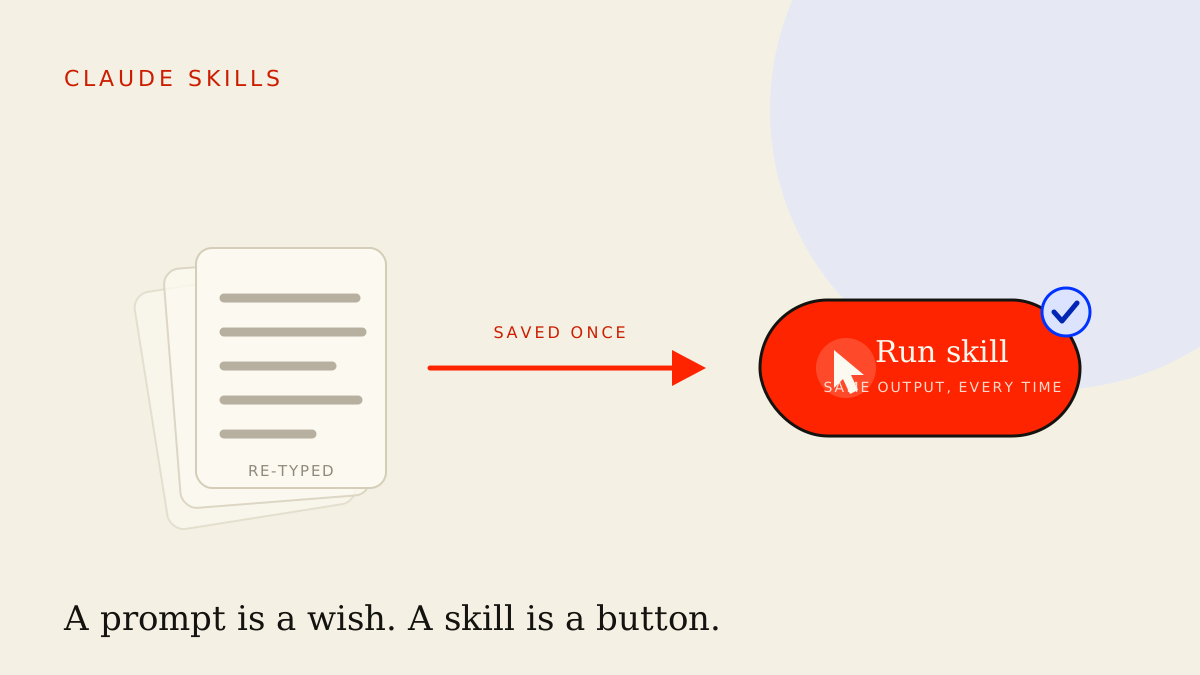
The principle is the same everywhere: capture context once, reuse it forever. This is the core orchestration habit — you are building reusable assets, not one-off prompts.
Step 4: Test and enforce it across chats
Loading the guide is not the finish line. You verify, then you enforce.
Run a paired test. Give the model an identical brief twice — once cold, once with the voice guide loaded — and compare. If you cannot tell the two apart, your guide is too vague. Go back and add concrete word-level rules.
Use a voice audit on every important draft. Make the model grade its own output against the guide before it ships:
Audit the draft below against our VOICE GUIDE (in this Project's knowledge).

For each, score 1-5 and quote the offending line:
- Tone match
- POV and directness
- Word list: any banned words? any missed signature words?
- Formatting defaults
- Did it commit any of our 3 hard bans?

Then rewrite ONLY the lines that scored 3 or below so they pass.
Return the scores, then the corrected draft.

DRAFT:
[paste draft]
Fight drift. In a long chat, your instructions get diluted as the context fills. When output starts sliding back to generic, re-anchor: paste the guide again, or just start a fresh chat. One task, one clean chat is a reliable rule.
Update the guide quarterly. Your best content changes. Re-run the Step 1 audit on your newest winners and fold anything new into the guide.
Key takeaways
- Blame the input, not the model — generic output means the AI is missing your context.
- Extract traits from your best content with quoted proof, never from a blank-page brainstorm.
- A one-page guide plus a do/don't word list beats a 12-page brand bible the model can't use.
- Make context persistent in a Project, Custom GPT, or custom instructions so you never re-paste.
- Verify with paired tests and a voice-audit pass, and re-anchor whenever long chats drift.
Brand voice is the first orchestration asset worth building, because every other workflow inherits it. Once your voice lives in a Project, every campaign, thread, and email starts on-brand for free.
Ready to build the full system? Start with the curriculum to set up your first voice Project, grab the ready-made audit and voice prompts from the prompt library, and see how voice plugs into the bigger picture in the AI marketing orchestration playbook.
Frequently asked
- Why does AI-generated content sound so generic?
- Generic output is almost always a context problem, not a model problem. The model defaults to a safe, average voice because you never told it who your brand is or showed it examples. Feed it a voice guide and real samples and the output changes immediately.
- What is the difference between a Project, custom instructions, and a system prompt?
- They are all ways to make context persistent so you do not re-paste it every chat. Claude Projects and ChatGPT Custom GPTs hold reference files and standing instructions, custom instructions apply globally to every chat, and a system prompt is the API-level version of the same idea. Pick whichever your team uses daily and load your voice guide there.
- How many content samples do I need to capture a brand voice?
- Three to five of your best-performing pieces is usually enough to extract clear, reusable traits. Quality matters far more than quantity, so pick the pieces you would proudly show a new hire rather than dumping your entire archive in.
- How do I stop the AI from drifting back to generic over a long chat?
- Long chats dilute your instructions as the conversation fills the context window. Re-anchor by pasting the voice guide again, starting a fresh chat for each new task, or keeping the guide in a Project so it reloads every time. A quick voice-audit pass on the draft also catches drift before it ships.
This is the thinking. The systems are the proof.
See how these ideas ship as working infrastructure.