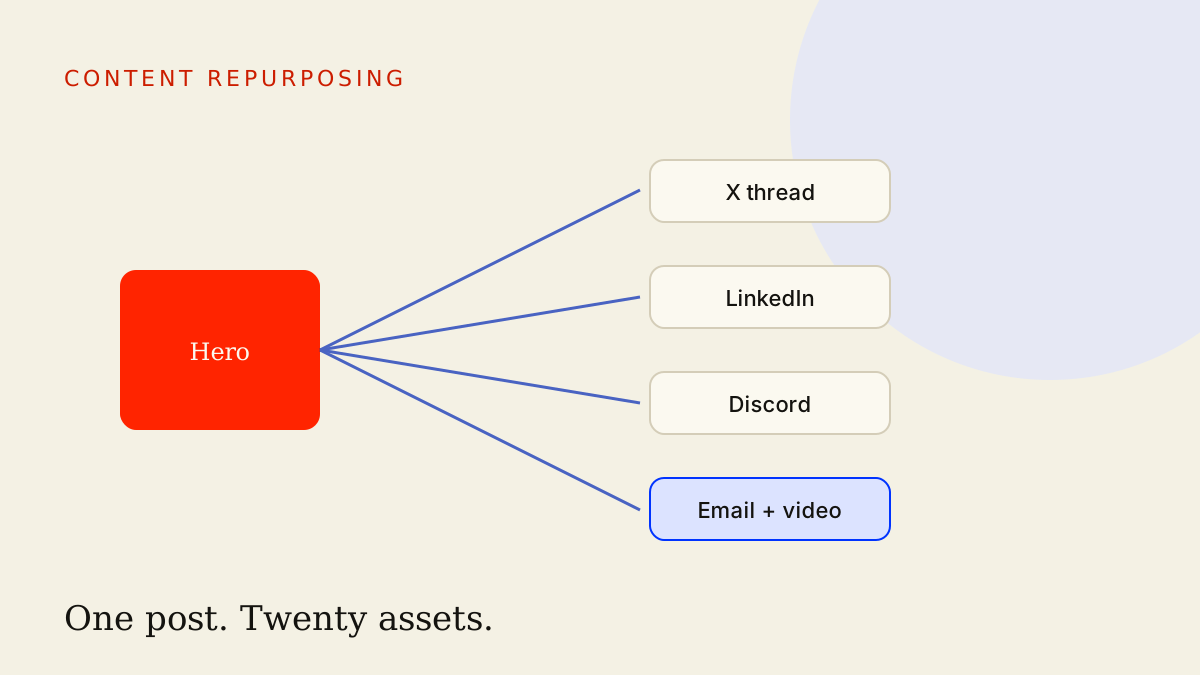
One Post, Twenty Assets: The AI Content Repurposing System
Turn a single hero asset into a full channel pack without losing your voice. The repeatable AI repurposing pipeline marketers use to multiply output.
By Dylan Morrow
 Journalcontent
You are not short on ideas. You are short on the eight hours it takes to turn one good idea into a week of posts across five platforms. So you write the long thing, post it once, and let it die.
That is the most expensive mistake in content. One strong idea should produce a dozen assets, not one. Here is the exact AI pipeline that does it without making everything sound like the same robot wrote it.
TL;DR
- Build around a hero asset: one deep piece per cycle that carries the original thinking. Everything else is derived.
- Run a fixed pipeline: research/angle → hero → fan-out → human pass. Same steps every week.
- Adapt channel-native, not copy-paste. An X thread and a LinkedIn post should share an idea, not a paragraph.
- Lock voice once with a reusable voice profile you paste into every prompt.
- Cadence beats intensity. One hero a week, fanned out, compounds faster than sporadic heroics.
Why one-and-done content is bleeding you out
When you publish a long post once, you reach the slice of your audience that happened to be online in that window. That is maybe 5 to 10 percent of your followers on a good day. The other 90 percent never see it.
Repurposing is not "lazy reposting." It is distribution math. The idea is good once; you just need it to show up in twelve places where your audience already lives, shaped for how they read in each place.
The trap is doing this by hand. By the time you've rewritten your essay into a thread, a LinkedIn post, three Discord messages, and an email, the day is gone. AI collapses that from hours to minutes — if you give it a pipeline instead of vibes.
Step 1: Pick a hero asset worth multiplying
Not every post deserves the full treatment. A hero asset has three traits:
- It has a spine. One clear argument or framework, not five loosely related thoughts.
- It's evergreen-ish. It'll still be true in three months, so the derived assets keep working.
- It rewards depth. There's enough substance that you can pull ten angles out of it without repeating yourself.
Good heroes: a contrarian take backed by your experience, a step-by-step framework, a teardown of something real, a "here's what I learned shipping X" recap. Bad heroes: news reactions and one-liners — they're already in their final form.
Write the hero properly. AI can help draft and sharpen it, but the original thinking has to be yours. The fan-out only multiplies what's there. Multiply a weak hero and you get twelve weak posts.
Step 2: The repurposing pipeline (the framework)
Run these five steps every cycle. The point is that it's fixed — you stop deciding and start executing.
- Research / angle. Define the spine in one sentence and list the audience this is for. Pull any data, examples, or sources you'll cite.
- Hero. Draft the long asset (essay, thread-of-record, video script, or recorded talk transcript). This is the source of truth.
- Extract. Have AI pull the 8–12 distinct ideas inside the hero — not sentences, ideas. This is your raw material.
- Fan-out. Rebuild each channel's asset from those ideas using channel-native prompts (next section).
- Human pass. You edit every asset for voice, accuracy, and the one detail AI always flattens — the specific, lived example.
Steps 3 and 4 are where AI earns its keep. Never let it skip step 1 (you'll get generic output) or step 5 (you'll get plausible-sounding garbage you didn't catch).
Step 3: Channel-native adaptation (so it doesn't sound copy-pasted)
The mistake everyone makes: they take the hero, ask AI to "make it shorter for X," and post the shrunk version everywhere. That's why repurposed content reeks of repurposing.
Each channel has a native grammar. Adapt to it:
X / thread
Punchy, one idea per line, a hook that earns the second line. Open with the sharpest claim, not a setup. No "here's a thread on…".
A story or a stance up top, white space, a soft lesson, one question to drive comments. Slightly more earnest than X. Never start with a hook formula that screams engagement bait.
Discord / community
Conversational, first-person, written to people not at them. Drop the polish. Ask for replies, share the messy version, invite disagreement.
One idea, one click. Short. Sound like a person emailing a friend, not a newsletter machine. The subject line is 80 percent of the job.
Short-form video script
Spoken rhythm, not written. Hook in the first two seconds, one beat per breath, a visual cue every few lines. Read it out loud — if you stumble, rewrite it.
Here's the prompt that rebuilds — not resizes — the idea into an X thread:
You are my X ghostwriter. Below is my VOICE PROFILE and a HERO ASSET.

Write a 7–9 post X thread that teaches the single most useful idea
in the hero. Rules:
- Post 1 is a hook: the sharpest claim or result, no setup, no "thread:".
- One idea per post. Short lines. No hashtags, no emojis unless my
  voice profile uses them.
- Rebuild the idea for X — do NOT shorten my essay. Use punchy,
  native phrasing.
- End with one line that invites a reply or a save.
Return only the thread, numbered.

VOICE PROFILE:
[paste profile]

HERO ASSET:
[paste hero]
Step 4: Hold your voice across everything
This is the part that separates "AI slop" from content people actually attribute to you. Write your voice profile once, reuse it forever.
A voice profile is a short, blunt spec: how you sound, what you never do, three example lines you'd actually write, and your hard rules (banned words, no em-dash overuse, no "in today's fast-paced world"). Keep it in your prompt library so every prompt starts with it.
Then paste it at the top of every fan-out prompt. The model anchors to it. Your human pass in step 5 catches the rest — especially the specific, real example AI loves to replace with a vague placeholder. That concrete detail is your fingerprint; never let it get sanded off.
If you run this across a team or multiple brands, the voice profile becomes the single source you version and share, so everyone's AI output lands in the same voice.
Here's the prompt that fans one hero into a full channel pack at once:
You are my content repurposing engine. Use the VOICE PROFILE for every output.

From the HERO ASSET below, produce a channel pack:
1. X thread (7–9 posts) — native, hook-first, one idea per line.
2. LinkedIn post (~150 words) — story or stance, white space, one question.
3. 3 Discord messages — conversational, first-person, invites replies.
4. Short email (~120 words) + 3 subject line options — one idea, one click.
5. 30–45s short-form video script — spoken rhythm, 2-second hook, visual cues.

Rules:
- Each output must REBUILD the idea for its channel. No reused paragraphs
  across formats.
- Stay in voice. Keep my specific examples; never replace them with
  generic placeholders.
- Flag anything you were unsure was factually accurate in a NOTES section.

VOICE PROFILE:
[paste profile]

HERO ASSET:
[paste hero]
That second prompt is the whole system in one call. Save it, swap the hero each week, done.
Step 5: The weekly cadence
Systems beat sprints. A realistic weekly rhythm:
- Day 1: Lock the angle and draft the hero (your deepest work).
- Day 2: Run the channel-pack prompt. Do your human pass on every asset.
- Day 3–5: Schedule and ship across channels, spaced out so the same idea hits different time windows.
One hero a week is roughly 40–50 native assets a month from four to five solid ideas. Compare that to publishing four long posts and hoping. The compounding isn't in any single post — it's in showing up everywhere, consistently, in your actual voice.
Illustrative range, but the shape holds: teams that move to a hero-and-fan-out model often see their output multiply several times over without adding headcount, because the AI handles transformation and the human handles judgment.
Key takeaways
- The hero asset is the only place you do original thinking — everything else is transformation, and AI is great at transformation.
- Fixed pipeline beats inspiration: research/angle → hero → extract → fan-out → human pass, every cycle.
- Rebuild per channel, never resize — that's the difference between native content and obvious repurposing.
- A reusable voice profile pasted into every prompt is what keeps twelve assets sounding like one person.
- Cadence compounds. One hero a week, fanned out, beats sporadic long posts every time.
Want the full system, not just the prompts? Start with the curriculum to build your repurposing pipeline end to end, grab the ready-made fan-out prompts in the prompt library, and level up the underlying workflows in the skills hub. For the bigger picture of running AI as a marketing system, read the orchestration playbook.
Frequently asked
- What is a hero asset in content repurposing?
- A hero asset is the single deepest piece of content you create in a cycle, like a long-form essay, a research breakdown, or a recorded talk. Everything else you publish that week is derived from it. The hero carries the original thinking, and the channel pack carries the distribution.
- Does AI-repurposed content all sound the same?
- It does if you skip channel-native adaptation and feed the AI no voice guardrails. The fix is a reusable voice profile plus channel-specific prompts that rebuild the idea for each platform instead of resizing the same paragraph. Done right, an X thread and a LinkedIn post can share a core idea while reading like two different native posts.
- How many channels should I repurpose one hero asset into?
- Start with three to five channels you can actually maintain, such as X, LinkedIn, your community, and email. Twenty assets is achievable but only matters if each one fits where it lands. More channels with worse fit will underperform fewer channels done natively.
- How long does this repurposing pipeline take per week?
- Once your voice profile and prompts are saved, a full hero-to-channel-pack cycle is roughly two to four hours of focused work. The hero asset is the bulk of it, and the AI-assisted fan-out plus your human edit pass is usually under ninety minutes. The first cycle takes longer because you are building reusable assets.
This is the thinking. The systems are the proof.
See how these ideas ship as working infrastructure.