The QA Layer Is the Moat: Human-in-the-Loop Systems for AI Marketing
Anyone can generate a demo now. The durable edge is the eval and QA layer that makes AI output trustworthy enough to ship at scale. Here's how to build it.
By Dylan Morrow
 Journaleval
You can generate a demo in an afternoon now. A slick prompt, a clever chain, a polished output you screenshot and send to your boss — everyone can do this in 2026. Then you try to run it on autopilot across a hundred real pieces, and it quietly invents a statistic, drifts off-voice, or ships a claim legal would have killed. The demo was never the hard part.
The hard part — the part almost nobody builds — is the layer that makes the output trustworthy enough to ship without you watching. That layer is your moat.
TL;DR
- Generation is commoditised; QA is not. Anyone can produce a draft. The rare skill is knowing whether a draft is good enough to ship, at scale, without reading every word.
- "It works in the demo" is not "I can run it on autopilot." A demo proves the happy path once. Autopilot survives the unhappy path a hundred times — that gap is the QA layer.
- Vibes-checking doesn't scale; a rubric does. Replace "does this feel right?" with named, scored criteria so the standard holds whether you're fresh or fried.
- Design review gates by stakes. Auto-run the cheap, reversible steps. Put human eyes only where being wrong is expensive — claims, numbers, compliance, anything under a client's name.
- Make the AI grade its own work first. A self-critique pass catches the obvious failures before they reach you, so your attention goes to the judgement calls a machine can't make.
Why "it works in the demo" is a trap
A demo is a single trip down the happy path. You picked the input, you watched the output, and you fixed anything weird in real time. Of course it worked — you were the QA layer, manually, in the loop, the whole time.
Autopilot is a different animal. Now the system runs on inputs you didn't hand-pick, produces outputs you don't read in real time, and ships them at a volume where you can't read them all. The failures that never showed up in the demo are exactly the ones that show up at scale, because scale is just more chances for the model to do something stupid.
This is the gap that sinks most AI marketing projects. The pilot dazzles in the meeting. The rollout dies three weeks later when someone notices the AI has been confidently citing a 47% stat that exists nowhere. The team blames the model and goes shopping for a better one — they were missing a layer, not a model.
A demo proves a thing is possible. A QA layer proves it's safe to repeat. Only the second claim is worth money.
Vibes-checking vs a real eval
Most people's "quality control" is reading the output and going yeah, that's good. This is vibes-checking, and it has one fatal flaw: your standards move.
On draft one you read every line. By draft ten you skim. By draft fifty, on a Friday, behind on three other things, you rubber-stamp. Your review quality degrades exactly as your volume goes up — the worst possible time for it to degrade.
A real eval fixes this by externalising the standard. You write down what "good" means once, as named criteria, and grade against it every time. The rubric doesn't get tired. It doesn't have a Friday.
The test of whether you have a real eval is simple: could two different people grade the same draft and land on the same verdict? If yes, you have an eval. If the answer depends on who's reading and what kind of day they're having, you have vibes wearing a lanyard.
What a real rubric contains
A usable rubric is specific, scored, and tied to evidence. For marketing output, the criteria that earn their place are usually:
- Voice match — does it sound like the brand, per the brand-voice guide, or has it drifted to the bland internet average?
- Factual support — is every specific number, name, and claim backed by the source material, or did the model invent it?
- Brief coverage — did it actually do what was asked, or answer a slightly easier question?
- Compliance — does it dodge the regulated phrases, required disclaimers, and forbidden claims for this client and channel?
- Format and structure — does it match the spec for the destination, ready to publish?
Each one gets a score, not a vibe. And critically, each one demands a quote — the line that proves the score — so the grade points at evidence instead of flattering the work.
Build a self-critique pass
Here's the move that turns a rubric from a document into a system: make the AI run the rubric on its own output before you ever see it.
A self-critique pass is a second prompt that hands the model its own draft plus the rubric and tells it to grade harshly, quote the offending lines, and rewrite only what fails. You're not trusting the model to be right — you're using it to clear the obvious failures so your scarce human attention lands on the judgement calls only you can make.
You are a ruthless QA editor. Below is a DRAFT and our RUBRIC.
Grade the draft against every criterion. Be adversarial — your job
is to find what's wrong, not to reassure me.

For EACH criterion, return:
- Score 1-5
- The exact quoted line(s) that justify the score (no score without a quote)
- A one-line reason

Criteria:
1. Voice match — sounds like our brand guide, not generic AI.
2. Factual support — EVERY number, name, date, and specific claim must
   trace to the SOURCE below. Flag anything that doesn't as
   [UNSUPPORTED] and quote it. This is the highest-priority check.
3. Brief coverage — does it deliver what the BRIEF asked, fully?
4. Compliance — any banned phrases, missing disclaimers, or claims we
   can't make for this channel?
5. Format — matches the required structure for publishing?

After scoring:
- List every line that scored 3 or below.
- Rewrite ONLY those lines so they would pass.
- If any [UNSUPPORTED] claim can't be fixed from the SOURCE, DELETE it
  and say so. Do not invent a source.

Return: the scorecard, then the list of failures, then the corrected draft.

BRIEF: [paste]
SOURCE: [paste the only material it's allowed to use]
RUBRIC: [paste or reference]
DRAFT: [paste]
Two things make this pass earn its keep. First, no score without a quote — it stops the model from generously awarding itself a 5 across the board. Second, the unsupported-claim rule forces deletion over invention, the single most common way AI output gets a marketer in trouble.
Run this and you'll watch the model catch its own hallucinated stat before you read a single word. What it doesn't catch is what your human gate is for.
Design your review gates
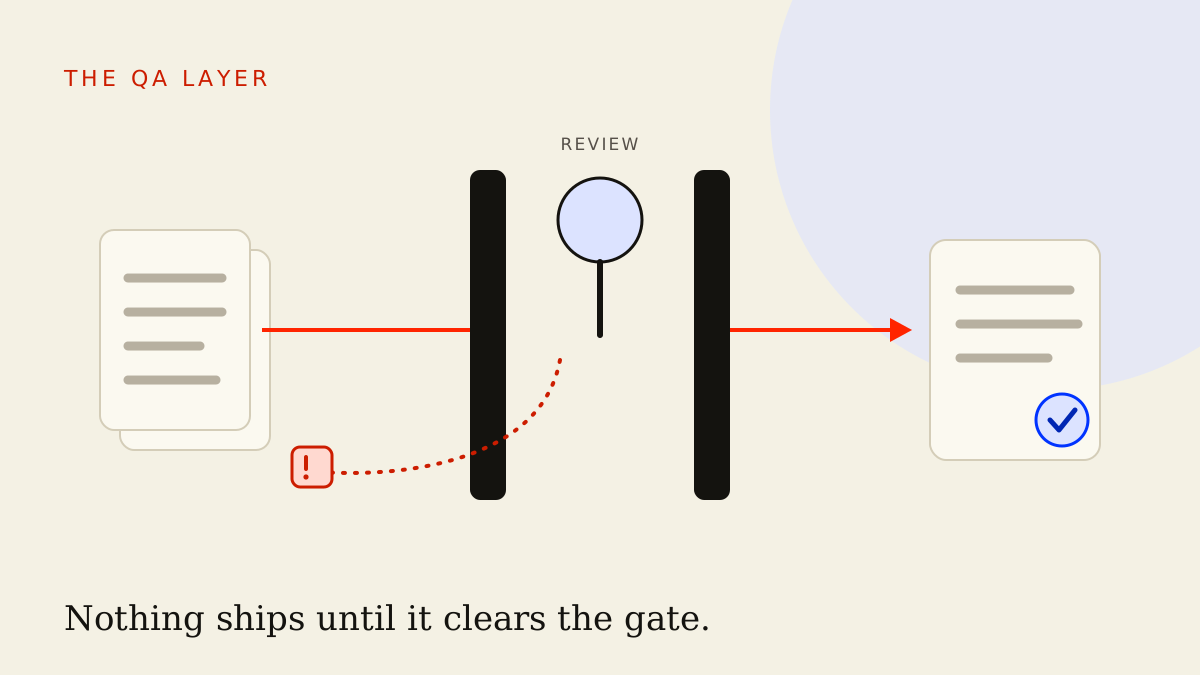
Not every step needs a human, and pretending it does is how you end up doing all the work anyway. The skill is deciding which steps auto-run and which need eyes — and the deciding principle is stakes.
The question for every step is: how expensive is it to be wrong here? Cheap and reversible? Let it run. Expensive or irreversible? Gate it.
- Auto-run the low-stakes work: research digests, first drafts, format conversions, internal summaries. If it's wrong, you catch it downstream at almost no cost.
- Human gate the high-stakes work: anything with a published number, a factual claim, regulated or financial language, or anything going out under a client's or executive's name. Here the cost of being wrong is a retraction, a fine, or a lost account.
This is the difference between an AI workflow you actually trust and one you babysit. A good gate concentrates your attention where it changes the outcome and removes it from where it doesn't. You're not reviewing less because you're lazy; you're reviewing the right things because you're deliberate.
A practical pattern: the AI self-critiques every step, auto-passes anything that clears the rubric clean, and escalates only the items that scored low or touch a high-stakes criterion. You stop reviewing a hundred drafts and start reviewing the eight the system flagged.
The failure modes you're actually defending against
Build the QA layer around the failures that actually happen, not hypothetical ones. Three account for most of the damage.
Hallucinated facts
The model states a number, a date, a quote, or a study that does not exist, in a confident voice indistinguishable from a real one. This is the most dangerous failure because it's invisible — the output looks perfect. The defence is the source-grounding rule: the model may only use facts from material you provided, and anything else gets flagged or deleted. Your gate then verifies every specific that survived. It matters even more when you're optimising for the generative engines that quote you — a hallucinated stat doesn't just embarrass you, it gets repeated.
Voice drift
Over a long output or a batch, the model slides back toward the safe internet average. The first paragraph sounds like you; the twentieth sounds like a press release. The defence is a voice-match criterion in the rubric and a hard reset between batches rather than one mega-prompt that drifts as its context fills.
Compliance breaches
The output says something a regulated client, a financial brand, or a specific platform can't legally or contractually say. The defence is a named compliance check with the actual banned phrases and required disclaimers loaded in, plus a non-negotiable human gate on anything regulated. This is not a step you let autopilot own.
This is what turns efficiency into leverage you can defend
Here's the part most people miss. Quietly using AI to work faster is invisible efficiency — your boss or client never sees it, can't verify it, and won't reward it. A QA layer is what converts that invisible efficiency into trustworthy leverage you can actually defend.
When a client asks "how do I know your AI-assisted content is reliable?", "I read it carefully" is a liability. "Every piece passes a five-criterion eval with source-grounded fact-checking and a human gate on all published claims" is an answer. One sounds like a risk; the other sounds like a process. The QA layer is the thing you show the room.
It also fixes the metric problem. Most AI projects measure speed because speed is easy to measure, and go quiet on quality because nobody set up a way to measure it — so you optimise the number you can see and the unmeasured one rots. When you measure AI marketing ROI properly, your rubric scores become the quality metric — pass rate, hallucination catch rate, escalation rate — sitting next to time saved. Now you can prove you got faster without getting worse, the only version of "faster" worth selling.
Eval design is the rare skill of 2026
Generation has gone to zero. The model writes the draft, and the model is, for most marketing work, good enough. That's precisely why it's no longer where the value is — when everyone can generate, generation stops being a differentiator.
What's scarce is the judgement layer: knowing what good looks like, encoding it into a rubric a machine can run, deciding where humans must stay in the loop, and proving the whole thing holds at scale. That's not prompt-writing. That's eval design, and it's the rare, defensible skill of this moment — the one that separates people who demo AI from people who operate it.
It's learnable, and almost nobody is doing it yet. Build the QA layer before your competitors realise it's the moat, and you'll be the operator clients trust with the work that actually matters.
Key takeaways
- The demo is free; the QA layer is the moat. "It works once" and "it's safe to repeat at scale" are different claims — build the second.
- Replace vibes-checking with a scored rubric so the standard holds whether you're fresh or fried, and two reviewers reach the same verdict.
- Make the AI self-critique first with a no-score-without-a-quote rule and a delete-don't-invent rule for unsupported claims.
- Gate by stakes — auto-run cheap reversible steps, put human eyes only where being wrong is expensive.
- Measure quality, not just speed so you can prove you got faster without getting worse — and defend it to any boss or client.
Build the layer everyone else skips. Start by capturing the voice your rubric will grade against in the brand-voice system, wire QA gates into your first real workflow, and put your rubric scores next to your speed numbers when you measure the ROI.
Frequently asked
- What is the QA layer in an AI marketing workflow?
- It's the set of checks an AI output passes through before it ships — an eval rubric, a self-critique pass, and a human review gate on the steps that carry real risk. The generation step writes the draft. The QA layer decides whether the draft is good enough to trust, and catches the failures that would otherwise reach your audience.
- Isn't reading the output myself enough quality control?
- Reading the output is vibes-checking, and it fails the moment you scale. You read carefully on draft one, skim by draft ten, and rubber-stamp by draft fifty. A rubric replaces your fluctuating attention with a fixed standard the work has to clear every time, whether you're fresh or fried.
- What's the difference between vibes-checking and a real eval?
- Vibes-checking asks 'does this feel right?' and the answer drifts with your mood and your deadline. A real eval scores the output against named, written criteria — voice match, factual support, compliance, brief coverage — so two people grading the same draft reach the same verdict. One is a gut feeling; the other is a measurement you can defend to a boss or client.
- Which steps should auto-run and which need a human?
- Auto-run the low-stakes, easily-reversible steps: research summaries, first drafts, format conversions. Gate anything that's hard to take back or carries legal, financial, or reputational risk — published claims, numbers, regulated copy, anything going out under a client's name. The rule of thumb: the cost of being wrong sets the height of the gate.
This is the thinking. The systems are the proof.
See how these ideas ship as working infrastructure.