AI Video Is the New Content Moat: The 2026 Creative Operator's Playbook
AI video tools collapsed production cost to near zero. The moat is now taste, systems, and a repeatable concept-to-distribution pipeline with a human QA gate.
By Dylan Morrow
 Journalai video
You can feel the floor dropping out. A clip that cost a five-figure shoot day two years ago now takes one prompt and eight minutes. Everyone on your feed figured this out at the same time, so the feed is filling with cinematic-looking video that says nothing, and yours risks getting buried in the same pile.
That is the real shift. The tools are no longer the advantage — everyone has them. The advantage is taste, a repeatable pipeline, and a human gate that separates signal from slop. This is how a lean team builds that moat.
TL;DR
- Text is commoditising, attention is moving to video. A generated essay and a generated caption now read identically across a thousand brands. Motion is where attention and differentiation still live in 2026.
- The moat is not access, it is taste plus systems. Owning Seedance or Veo means nothing when your competitor owns them too. The repeatable pipeline is the asset.
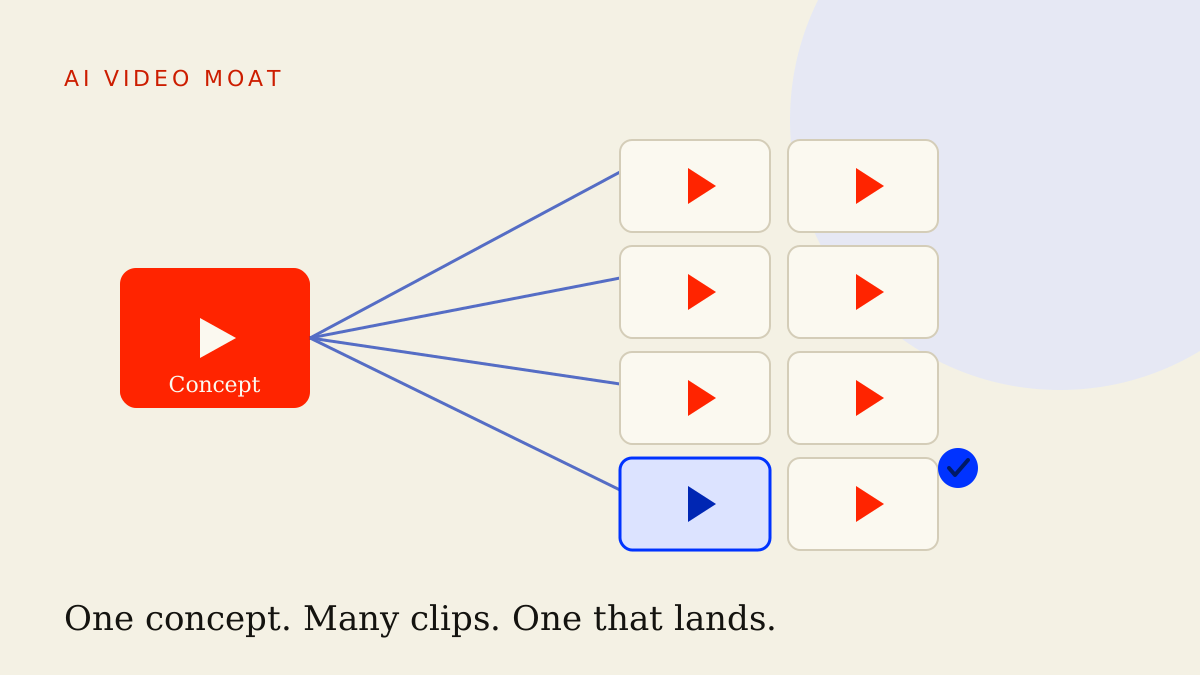
- Run a fixed pipeline: concept → generate → edit → distribute, with a human QA gate between generate and edit that kills weak clips before they cost you editing time.
- Brand consistency comes from locking inputs, not from fixing outputs. Same references, same grade, same prompt skeleton, every clip.
- Volume without a gate is just faster slop. The operator's job is judgement at scale, not generation at scale.
Why text went commodity and video became the currency
Two years ago, a competent AI-written LinkedIn post was a small edge. Now every brand has one, they all sound the same, and the reader's eye slides straight past. Text content has hit the commodity floor — infinite supply, near-zero marginal cost, almost no differentiation left in the medium itself.
Video did not collapse the same way, because video carries things text cannot fake cheaply: pacing, motion, performance, atmosphere, a point of view you can feel in three seconds. That is exactly what platform algorithms reward, and it is where audience attention actually pools.
What changed in 2026 is that the cost of video collapsed while the value of attention did not. Cinematic, platform-native video went from a budget line to a prompt. When supply of decent-looking video explodes, the scarce thing is no longer production — it is the judgement to make video worth watching. That gap is your moat.
The new moat is taste, systems, and a pipeline
Here is the uncomfortable part for anyone who built their identity on tool access. A tool you share with ten thousand competitors is not a moat. Seedance, Higgsfield, Veo, Runway — the model you pick this quarter is a coin toss, and they all leapfrog each other anyway.
The defensible assets are different:
- Taste — knowing in two seconds whether a clip lands or reeks of AI, and being right.
- Systems — saved references, prompt skeletons, a grade and type system you reuse on every clip.
- A pipeline — a fixed path from idea to published, so you are executing instead of reinventing.
A team with mediocre tools and a sharp pipeline beats a team with the best tools and no system, every time. The pipeline is what compounds; the tool is replaceable on a Tuesday.
The AI video stack by job
Do not think in tools, think in jobs. Pick one option per job and learn it deeply. Here is the stack a lean operator actually needs in 2026.
Ideation
Concept is still the bottleneck, and it is the one job you should not fully automate. Use an LLM to pressure-test and expand angles, not to hand you the idea. Feed it your brand context and ask for ten distinct hooks, then you pick the one with a real point of view. The model widens the funnel; you make the call.
Generation
This is the cost-collapse layer: Seedance, Higgsfield, Veo, Runway-class models. Master one generator before you touch a second. Depth in one tool — how it handles references, motion, character locks, prompt phrasing — beats shallow familiarity with five. Switching costs are low; mastery is not.
Editing and assembly
Generated clips are raw stock, not finished posts. You need a fast cut tool to trim, sequence, pace, and add B-roll. The edit is where a four-second hook gets sharp enough to stop a thumb. Most "bad AI video" is actually badly edited AI video.
Voice and sound
Sound is half the perceived quality and the half most operators skip. AI voice and SFX tools give you a consistent narrator and a sound bed without a booth. A flat clip with great audio outperforms a gorgeous clip with dead silence.
Captions and packaging
Most short-form is watched on mute. Burned-in captions, a consistent caption style, and a strong thumbnail or first frame are not afterthoughts — they are the difference between a scroll-past and a watch. This is also where your brand type system does quiet, constant work.
The repeatable pipeline: concept → generate → edit → distribute
Stop deciding the steps every time. Fix the pipeline so you spend your judgement on the work, not on the process. Four stages, with a gate that does the heavy lifting.
- Concept. Define the single idea and the hook in one sentence. Name the platform and aspect ratio before you generate anything. No concept, no generation.
- Generate. Run the prompt skeleton with your locked references. Produce several variations per concept — three to five — because generation is cheap and selection is where quality is made.
- QA gate (human). Score every variation. Most die here. Only the clips that clear the bar move to editing. This step is the whole moat; the next section is dedicated to it.
- Edit and distribute. Cut the survivors, add captions and sound, then ship native to each platform — vertical for TikTok and Reels, the right length and first frame for each.
The order matters. Generating before you have a concept gives you pretty noise. Editing before the QA gate wastes your scarcest resource — editing time — on clips that were never going to land.
Here is a prompt skeleton you can paste into your generator and reuse across every clip. Lock the bracketed fields once per brand and only change the concept line:
ROLE: You are generating one platform-native short-form video clip.

BRAND LOCKS (do not deviate):
- Visual style: [e.g. high-contrast, warm grade, 35mm grain, shallow depth]
- Subject/character lock: [reference image or description, keep consistent]
- Palette: [2-3 hex or named colours]
- Mood: [e.g. confident, kinetic, slightly surreal]
- Aspect ratio: 9:16   Duration: [4-8s]   No on-screen text

CONCEPT (changes per clip):
- Hook in first 1s: [the single arresting image or action]
- Beat: [what happens across the clip — one idea only]
- Camera: [e.g. slow push-in, handheld, locked-off]

OUTPUT: A clip that opens on the hook in frame one. No establishing
filler. Motion and pacing must feel native to short-form, not
like a slow stock loop.
The QA gate: how to separate slop from signal
This is the part nobody wants to do, which is exactly why it is the moat. Volume without a gate is just faster slop. A generator that produces twenty clips an hour is worthless if you publish all twenty; it is powerful only if you can kill nineteen and keep the one that lands.
Build a blunt rubric and score every clip against it before it earns an edit. A workable five-point gate:
- Hook in one second. If the first frame does not arrest, it fails. No exceptions.
- Point of view. Does this say something a thousand other brands wouldn't? Generic = dead.
- The tell test. Any melting hands, dead eyes, warped text, uncanny motion? One obvious AI tell and it fails — the audience clocks it instantly.
- On-brand. Does it match the locked grade, palette, and mood, or did the model drift?
- Would you stop? If you would scroll past it, so will everyone else. Be honest.
A clip ships only if it clears all five. Three out of five is not a pass — it is a slow-motion brand erosion. The discipline of killing your own clips is the entire skill; the generation around it is the easy part.
The mistake lean teams make is treating cheap generation as license to publish everything. The opposite is true: when each clip costs almost nothing, the only thing that signals quality is what you refuse to publish.
Holding brand consistency across many clips
The failure mode at volume is drift — fifty clips that each look fine alone but feel like fifty different brands together. Consistency comes from locking inputs, not from policing outputs after the fact.
Lock these once and reuse them on every generation:
- Reference frames and character locks so faces, products, and style hold across clips.
- A fixed colour grade and palette applied in the edit even when the model drifts.
- A type and caption system — same font, placement, and motion on every clip.
- The prompt skeleton above, so brand rules are baked into every generation request.
- One narrator voice across all clips so the brand sounds the same, not just looks the same.
Treat these as a small, versioned brand kit for video. When everything starts from the same locked inputs and passes through the same gate, fifty clips read as one coherent brand instead of fifty experiments. If you have not built a reusable voice spec yet, that is the foundation underneath all of this.
Distribution: native or nothing
A great clip posted wrong still dies. Each platform has a native grammar, and the algorithm rewards fluency in it. Repackage, do not repost.
- TikTok / Reels / Shorts: 9:16, hook in frame one, sound-on design but caption-safe for mute, 7–15 seconds for most concepts.
- YouTube: a strong thumbnail and first frame carry the click; longer-form assembled clips can live here.
- X / LinkedIn: subtitle everything, design the first frame to make sense paused, and lead with the payoff.
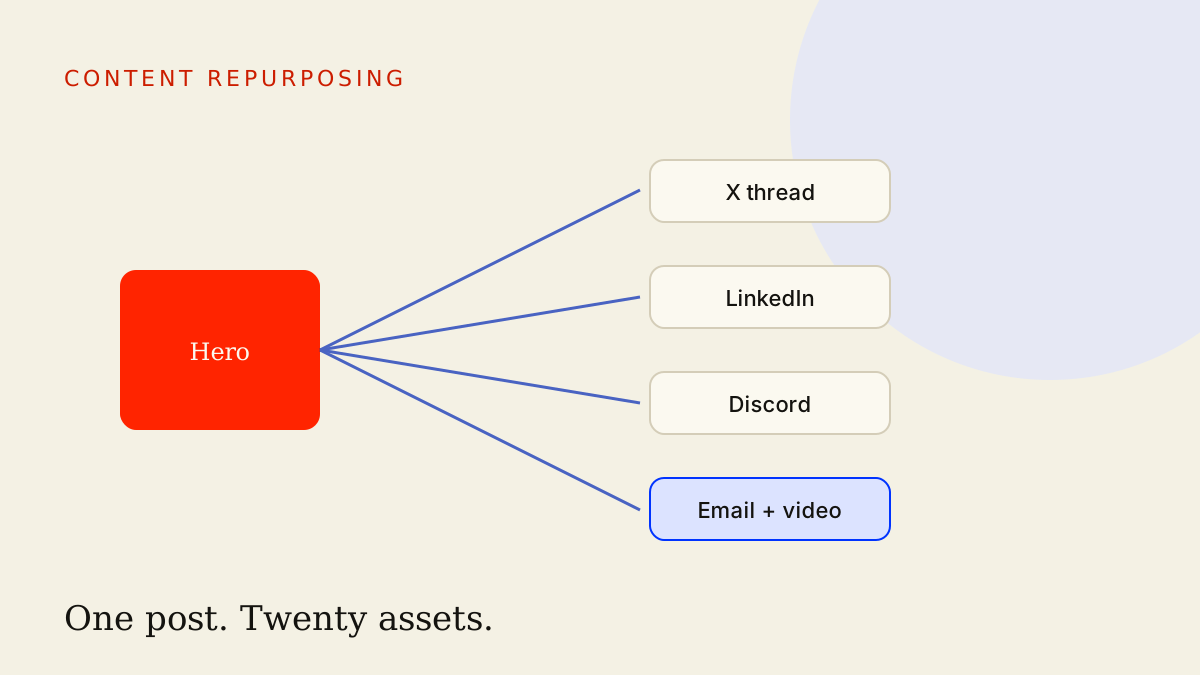
Run one concept into multiple native cuts rather than one master file blasted everywhere. The same hook, recut for each platform's grammar, is the video version of a content multiplication system — one idea, many native assets.
Key takeaways
- Text is commodity; motion is the attention currency. Differentiation moved to video because cost collapsed but the value of attention did not.
- The tool is not the moat. Taste, systems, and a repeatable pipeline are what your competitors can't copy by buying a subscription.
- The pipeline is fixed: concept → generate → edit → distribute, with a human QA gate doing the real work between generate and edit.
- The gate is the skill. Cheap generation only becomes quality when you ruthlessly kill the clips that don't clear the bar.
- Lock inputs for brand consistency, then ship native. Same references, grade, type, and voice — recut for each platform's grammar.
The operators who win in 2026 won't be the ones with the best generator — they'll be the ones running the tightest system around it. Build the underlying machine in the build-first AI marketing workflow, fold video into your wider content repurposing system, and lock the brand layer first with a brand voice the AI will actually respect.
Frequently asked
- Will AI video replace human creative operators?
- No — it replaces the parts of the job that were never the value. AI handles generation; the operator handles concept, taste, and the QA gate that decides what ships. The skill shifts from making each clip by hand to running a pipeline that produces twenty good clips and kills the bad ones fast.
- Which AI video tools should a lean team actually use?
- Pick one generator you know deeply rather than five you use shallowly. Seedance, Higgsfield, Veo, and Runway-class tools all clear the bar for platform-native short-form in 2026. Your edge comes from the system around the tool — references, prompt structure, and editing — not from which model you picked this quarter.
- How do you keep AI video on-brand across many clips?
- Lock the inputs, not the outputs. Reuse the same reference frames, character locks, colour grade, type system, and a fixed prompt skeleton across every generation. Brand consistency comes from controlling what goes into the model, then enforcing it at a QA gate before anything is published.
- Is AI-generated video penalised on TikTok, Reels, or YouTube?
- Platforms penalise low-effort, low-retention content, not the tool that made it. A clip that holds attention and feels native performs regardless of how it was generated. The losing pattern is obvious slop — flat pacing, dead-eyed avatars, no point of view — which is exactly what the QA gate exists to catch.
This is the thinking. The systems are the proof.
See how these ideas ship as working infrastructure.