Measuring AI Marketing ROI: The Metrics That Actually Matter
Time saved is a vanity metric. A framework for measuring the real ROI of AI in your marketing — from output velocity to revenue impact.
By Dylan Morrow
 Journalroi
Your team says AI is "saving us 10 hours a week." Great. Now walk into your CFO's office and say that. Watch their face. Time saved is the participation trophy of AI metrics — it feels like progress, but it proves nothing about whether the business made more money. Real ROI shows up downstream: in how much you ship, how it performs, and what it earns.
TL;DR
- Hours saved is an input, not a return. It only counts if you reinvest those hours into work that drives outcomes.
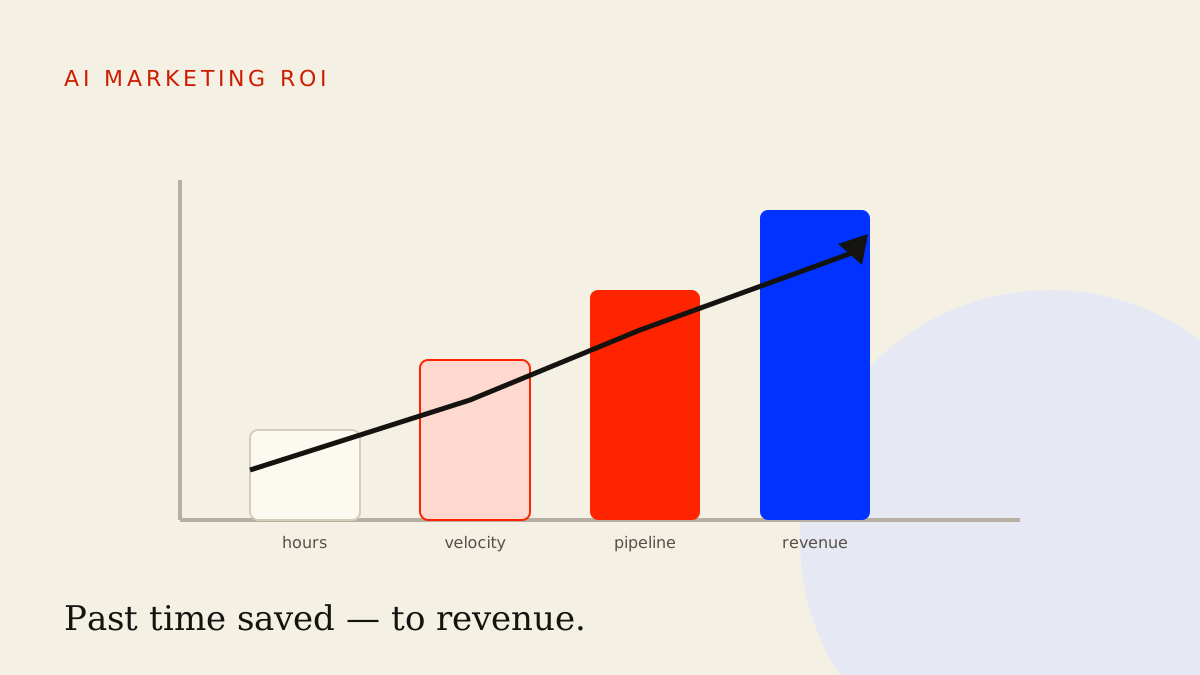
- Measure AI across three tiers: inputs (time), outputs (velocity, volume, consistency), and outcomes (engagement, pipeline, revenue, retention).
- Attribute conservatively. Isolate one variable, compare before/after, and say "contributed to," not "caused."
- A 15-minute monthly log beats a fancy dashboard nobody updates.
- Report to stakeholders in outcome language, not tool language — and let AI draft the read-out for you.
Why "time saved" alone misleads
Here's the trap. You roll out Claude or ChatGPT, your team feels faster, and someone reports "we saved 40 hours this month." Leadership nods. Three months later they ask, "So what did we get for it?" — and the room goes quiet.
Saved time is only potential energy. It becomes ROI in exactly one way: you spend those reclaimed hours on work that produces a result. If your team saved 10 hours and used them to attend more meetings, you generated zero return. If they used them to ship three extra campaigns that drove pipeline, now you have a story.
Worse, time-saved estimates are almost always self-reported and inflated. They're directional at best. Anchoring your entire AI business case on a soft, unverifiable number is how you lose budget the moment scrutiny arrives.
The tiered ROI framework
Stop measuring AI on one axis. Use three, in order. Each tier should pull through to the next — if your inputs improve but outputs don't, you have a reinvestment problem.
Tier 1 — Input metrics (effort)
This is your cost-and-capacity layer. Useful for understanding leverage, useless as a final answer.
- Hours saved per workflow — measure per repeated task (e.g., drafting a newsletter), not vaguely "across the team."
- Cost to produce — tool spend plus human time per asset. AI should bend this curve down.
- Cycle time — how long from brief to first usable draft.
Treat Tier 1 as a leading indicator. It tells you leverage exists. It does not tell you that leverage paid off.
Tier 2 — Output metrics (production)
This is where reinvested time becomes visible. Output metrics are the proof that saved time turned into more shipped work — not more idle time.
- Velocity — assets shipped per period (posts, emails, landing pages, scripts).
- Volume — total throughput, e.g., channels you can now cover that you couldn't before.
- Consistency — cadence reliability and on-brand adherence. AI's quiet superpower is never missing a publish date.
A realistic, illustrative example: a two-person team that shipped 8 long-form posts a month moves to 14 after orchestrating AI into their drafting workflow — same headcount, same hours. That delta is the bridge between effort and outcome.
Tier 3 — Outcome metrics (business impact)
This is the only tier leadership truly cares about. Everything else is setup for this.
- Engagement — CTR, time-on-page, reply rates, share velocity on the extra volume you shipped.
- Pipeline — leads, demos, qualified opportunities influenced by AI-assisted content.
- Revenue — closed-won influenced by those campaigns.
- Retention — for lifecycle and community work, churn and reactivation on AI-assisted touchpoints.
The chain you're proving: time saved → more shipped → more reach → more pipeline → more revenue. Break the chain at any link and your ROI claim collapses. Show all the links and it's bulletproof.
| Tier | Question it answers | Example metrics | Who cares |
|---|---|---|---|
| Input | "Did AI create leverage?" | Hours saved, cost/asset, cycle time | You / ops |
| Output | "Did we use the leverage?" | Velocity, volume, consistency | Marketing lead |
| Outcome | "Did it move the business?" | Engagement, pipeline, revenue, retention | Leadership / finance |
How to attribute fairly without overclaiming
The fastest way to lose credibility is to claim AI "drove $200K in revenue." Nobody believes single-cause attribution, and you shouldn't offer it.
Attribute like a scientist, not a salesperson:
- Isolate one variable. Introduce AI into one workflow and hold the rest steady. Mixed changes mean unprovable claims.
- Compare before and after. Take a clean 60–90 day baseline, then the same window post-rollout.
- Use a holdout where you can. Run one channel AI-assisted and a comparable one the old way.
- Speak in contribution, not causation. "AI-assisted content contributed to a higher publishing cadence, which coincided with a lift in organic leads." That sentence survives audit. "AI made us $200K" does not.
Underclaiming with evidence beats overclaiming with vibes — every time. Conservative numbers you can defend earn more budget than impressive numbers you can't.
A simple monthly tracking method
Forget the 12-tab dashboard. You'll abandon it by week three. Use a single log you can fill in in 15 minutes a month:
- One row per AI-assisted workflow. Name it (e.g., "Weekly newsletter," "LinkedIn thought-leadership").
- Three columns of metrics — one from each tier (e.g., hours saved, assets shipped, engagement rate).
- A "reinvestment note" — one line on where the saved hours actually went.
- A month-over-month delta so trends, not snapshots, drive the story.
The reinvestment note is the secret weapon. It forces the question that exposes fake ROI: did the saved time actually go somewhere that mattered?
How to report it to stakeholders
Leadership doesn't want metrics. They want a narrative with numbers attached. Lead with the outcome, support with output, mention input last (or not at all).
Feed your monthly log into this prompt and let AI assemble the read-out:
You are my marketing analyst. Turn the raw metrics below into a
stakeholder ROI read-out for our leadership team.

CONTEXT:
- Audience: [CMO / founder / finance]
- Reporting period: [month/quarter]
- AI tools in use: [Claude, ChatGPT, etc.]
- Workflows AI assists: [list]

RAW METRICS (treat any numbers as provided, do not invent new ones):
- Input: [hours saved, cost per asset, cycle time]
- Output: [assets shipped this period vs last, channels covered, cadence]
- Outcome: [engagement, leads/pipeline, revenue influenced, retention]
- Reinvestment notes: [where saved time went]

RULES:
- Lead with outcomes, not hours saved.
- Use "contributed to" / "coincided with" — never claim sole causation.
- Flag any metric that lacks a clean before/after as "directional."
- Keep it to: 3-sentence summary, a tiered metrics table,
  and 2 recommendations for next period.
- Plain language. No hype. A skeptical CFO is reading this.
Tighten the brackets, paste your numbers, and you get a defensible report in seconds — built on outcomes, not vanity.
Key takeaways
- Hours saved is potential, not return. It only counts when reinvested into outcome-driving work.
- Move up the tiers: inputs prove leverage, outputs prove you used it, outcomes prove it mattered.
- Attribute conservatively — isolate variables, compare before/after, and say "contributed to."
- A 15-minute monthly log with a reinvestment note beats any dashboard you won't maintain.
- Report in outcome language. Let AI draft the read-out, then pressure-test every number.
Get the systems behind the metrics
Measuring ROI is downstream of building workflows worth measuring. Start there:
- Follow the curriculum to build orchestrated AI systems that actually move outcome metrics.
- Grab the reporting and analysis prompts in the prompt library.
- New to this? Start with build your first AI marketing workflow — then come back and measure it properly.
Frequently asked
- Why is 'time saved' a bad way to measure AI marketing ROI?
- Time saved measures effort, not value. Hours freed up only become ROI if you reinvest them into work that drives outcomes like pipeline, engagement, or retention. On its own, time saved tells leadership nothing about whether AI made the business money.
- What metrics should I track instead of hours saved?
- Track three tiers: input metrics like hours saved, output metrics like content velocity and consistency, and outcome metrics like engagement, pipeline, and revenue. Outcome metrics are what leadership cares about, and they are the only tier that proves AI actually moved the business.
- How do I attribute results to AI without overclaiming?
- Attribute conservatively by isolating one variable at a time and comparing periods before and after you introduced AI into a workflow. Use directional language like 'contributed to' rather than 'caused,' and never claim full credit for revenue that many factors influence. Honest, narrow claims build more trust than inflated ones.
- How often should I report AI marketing ROI to stakeholders?
- Run a lightweight monthly review that logs output and outcome metrics against the prior month, then roll it into a quarterly narrative for leadership. Monthly cadence is frequent enough to catch trends early without creating reporting overhead that eats the time AI saved you.
This is the thinking. The systems are the proof.
See how these ideas ship as working infrastructure.