From Assistant to Agency: Building a Multi-Agent Marketing System
One AI doing everything is a generalist that does each job adequately. A multi-agent system runs like a small agency — specialists coordinated by an orchestrator.
By Dylan Morrow
 Journalmulti agent
You can feel where one assistant runs out of road. You open a chat, ask it to research a topic, then strategise, then write the post, then tighten it, then cut it into ten social posts — all in the same conversation. By the fourth task it's contradicting its own research, the voice has drifted, and you're the one holding it together.
That's not a model problem. It's an org-chart problem. You've asked one generalist to be a whole agency — and a generalist does every job adequately and no job well.
TL;DR
- One assistant doing everything is a generalist. It does research, strategy, writing, and editing each at "fine," because one context window juggling five jobs degrades at all of them.
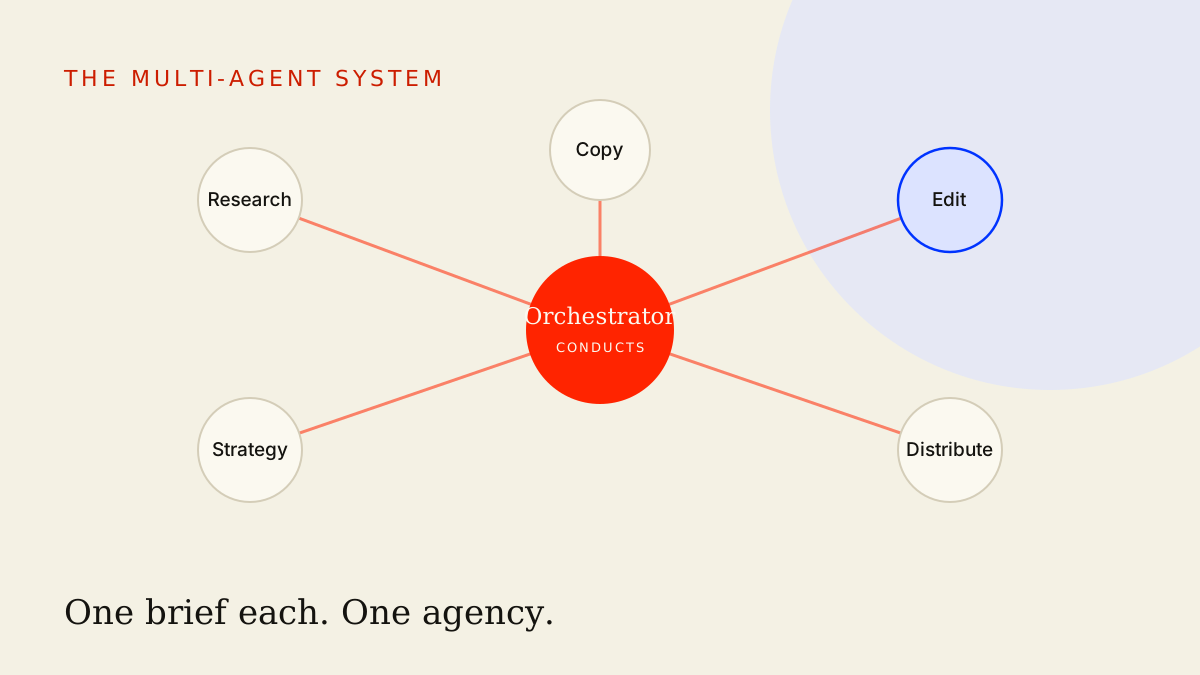
- A multi-agent system is a small agency. Each agent gets one job, one brief, one output — researcher, strategist, copywriter, critic, distributor — coordinated by an orchestrator.
- The orchestrator is the conductor, not a doer. It decomposes the task, routes briefs to specialists, assembles their outputs, and decides what gets reviewed.
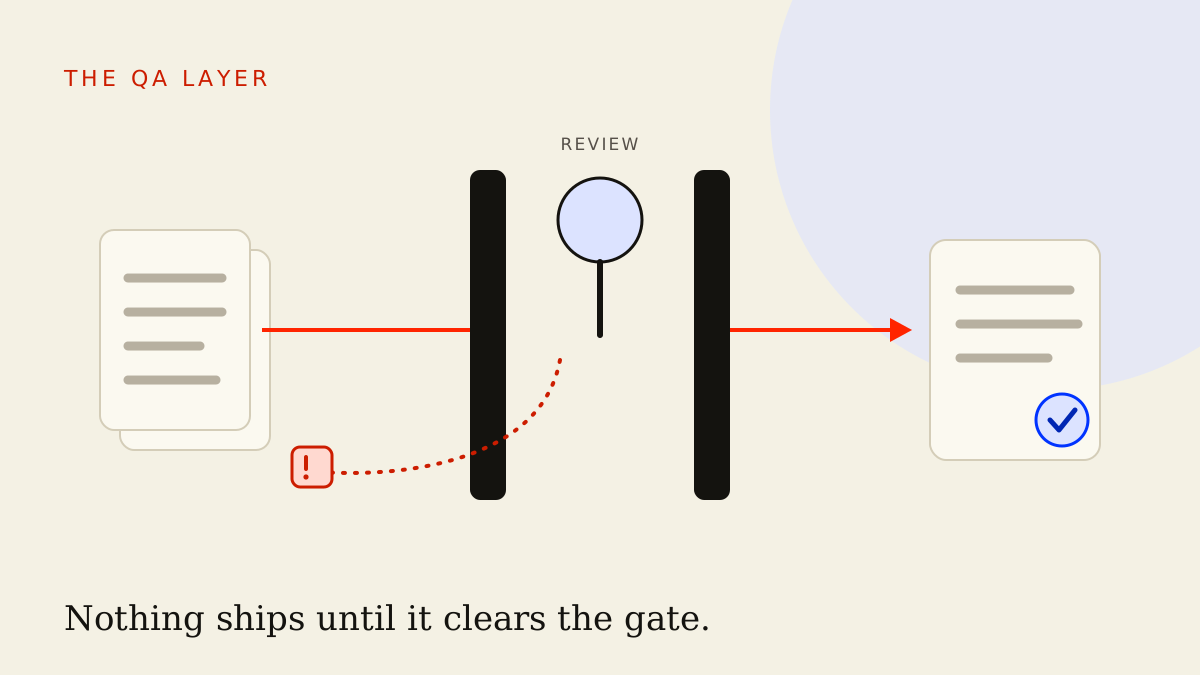
- The critic agent is your QA gate. A dedicated editor running in a fresh context catches what the writer is too close to see — it's the difference between a draft and a reviewed draft.
- Don't over-engineer. Multi-agent earns its keep when the job has real hand-offs. For single-step work, one good agent with a brand brain wins.
Why one context window doing everything degrades
A single chat has one context window and one running train of thought. That's perfect for one task. It's a liability for five.
When you stack research, strategy, drafting, and editing into one conversation, three things go wrong. The context fills with its own earlier output, so by the time it's editing, half its attention is spent re-reading research it half-remembers. The voice drifts toward the bland internet average the further a generation gets from your opening instruction. And the roles bleed, so the "editor" is really the writer marking its own homework — and it always gives itself an A.
The deeper issue is that these jobs want opposite mindsets. A researcher should be expansive and sceptical. A copywriter should be decisive and economical. A critic should be adversarial. Ask one context to be all three and you get the mush in the middle — expansive enough to ramble, decisive enough to commit to weak ideas, critical enough to nitpick but never to kill.
You've felt this as a ceiling. The fix isn't a cleverer mega-prompt. It's more agents, each with a narrower job.
The agency metaphor: one job, one brief, one output
Stop picturing a smarter assistant. Picture a small agency you're running.
In a real agency, you don't hand one person the whole campaign and walk away. You brief a researcher to come back with the landscape. A strategist picks the angle. A copywriter drafts it. An editor tears the draft apart and sends it back. A distributor turns the approved piece into channel-ready assets. Each person has one job, receives one brief, and returns one output.
A multi-agent system is the same shape, built from AI agents instead of people. The discipline that makes it work is the discipline that makes an agency work:
- One job. Each agent does a single thing. The researcher doesn't write. The writer doesn't strategise. Narrow scope is what lets each one be good rather than adequate.
- One brief. Each agent gets a clean, specific brief — and crucially, a fresh context. The copywriter doesn't inherit the researcher's 4,000 words of notes; it gets the strategist's tight angle and the brand brain. Clean inputs, clean output.
- One output. Each agent returns one well-defined deliverable in a known format, so the next agent (or the orchestrator) can use it without untangling.
This is the leap. A prompt asks one mind to wear five hats. An agency gives five minds one hat each. The second produces sharper work because nobody is context-switching mid-thought.
It only works if every agent shares a foundation. Each should be loaded with the same brand brain — voice, audience, offers, banned phrases — so five specialists still sound like one brand. The metaphor breaks the instant your researcher and your copywriter work from different definitions of who you are.
The orchestrator: conductor, not doer
The agent that makes this an agency rather than a pile of disconnected prompts is the orchestrator. The most important thing about it is what it doesn't do: it doesn't research, strategise, write, or edit. It conducts.
The orchestrator has four jobs.
- Decompose. Take the goal — "launch this feature to this audience" — and break it into the briefs each specialist needs.
- Route. Hand each specialist its brief and only its brief. The strategist gets the research, not the raw web. The writer gets the angle, not the strategist's deliberations.
- Assemble. Collect the specialists' outputs and stitch them into the finished deliverable.
- Gate. Decide what gets sent to the critic, what passes automatically, and what comes back to you.
Think of it as the conductor of an orchestra. The conductor plays no instrument. Their entire value is deciding who plays when, and how the parts fit. A weak orchestrator is a conductor who grabs a violin and starts playing — now you have one more mediocre musician and nobody keeping time.
Practically, the orchestrator can be a single prompt that delegates to sub-agents (or to fresh sessions you spin up role by role) and assembles what comes back. Here's a starter you can adapt. Paste your brand brain above it so every delegated brief inherits it.
You are my campaign orchestrator. You do NOT research, write, or edit
yourself. You decompose the task, write a brief for each specialist,
assemble their outputs, and route the draft through the critic.

GOAL: Launch [feature] to [audience] on [date]. Primary metric: [signups].

Run this pipeline. For each step, write the brief, then act as that
specialist in a clean context — do not carry over the previous step's
working notes, only its OUTPUT.

1. RESEARCHER — brief: find 5 angles competitors aren't using, each with
   the reason it works and one supporting fact. Return: a ranked list.
2. STRATEGIST — brief: given the research, pick the single strongest
   angle and a 3-beat narrative. Return: the angle + narrative, nothing else.
3. COPYWRITER — brief: given ONLY the chosen angle, the narrative, and the
   brand brain, write one long-form post and one email, in our voice.
   Return: the two drafts.
4. CRITIC — brief: grade the drafts against the rubric below. Quote the
   line behind every score. Rewrite only what fails. Return: scorecard +
   corrected drafts.
5. DISTRIBUTOR — brief: turn the approved long-form post into 5 standalone
   short posts and a 7-day calendar mapping each asset to a day and channel.

CRITIC RUBRIC: voice match / factual support (every claim traceable) /
brief coverage / hook strength / format. Score each 1–5; no score
without a quoted line.

After step 4, show me the scorecard and pause for my approval before
distribution.
That one run replaces a research session, a strategy doc, two drafting sessions, a review pass, and a repurposing grind — and because each step ran in a clean context with one job, none of them degraded.
The critic agent is your built-in QA gate
Of all five roles, the one most people skip is the one that matters most: the critic, or editor.
Here's why a separate critic beats "ask the writer to check its work." The writer is inside the draft. It chose those words for reasons it still finds compelling, so when you ask it to review, it rationalises rather than interrogates. A critic agent in a fresh context has no ego in the draft. It reads the words on the page, not the intentions behind them — exactly like a real editor who didn't write the piece.
Give the critic a fixed rubric, not a vibe. "Make this better" produces fiddling. A rubric produces judgement:
- Voice match — does it sound like the brand voice, or has it drifted to generic AI?
- Factual support — is every number, name, and claim traceable to the research, or did the writer invent it?
- Brief coverage — did it answer the brief, or a slightly easier question?
- Hook strength — would the first line stop a scroll?
- Format — is it ready to publish in the destination?
The non-negotiable rule: no score without a quoted line. Force the critic to point at the exact text behind each grade and it can't generously award itself a 5 across the board. Then have it rewrite only what fails and hand the corrected draft back to the orchestrator.
This is the move that turns a clever demo into something you can run at scale. A draft is free now; the rare, defensible skill is the QA layer that makes output trustworthy enough to ship without reading every word. The critic agent is that layer, built into the pipeline rather than bolted on after.
How the work actually flows
Put the pieces together and the flow has a clear shape: fan-out, assemble, review.
Fan-out. The orchestrator decomposes the goal and dispatches briefs. Some steps are sequential — the strategist needs the research before it can choose an angle. Some run in parallel — once the angle is set, a long-form draft and an email draft can be written at the same time by two copywriter instances, because neither depends on the other. Knowing which is which is half the orchestrator's skill.
Assemble. Specialists return their one output each, in known formats. The orchestrator stitches them into the candidate deliverable. Nothing here is creative; it's logistics. The cleaner each agent's output contract, the less assembly costs.
Review. The candidate goes to the critic. Clean passes flow through. Anything that fails the rubric loops back — to the writer with specific fixes, or escalated to you if it's a judgement call a machine shouldn't make. You stop reviewing every draft and start reviewing the few the system flags.
This mirrors how a competent agency moves a brief from kickoff to shipped: parallel where it can be, sequential where it must be, with a hard review gate before anything goes out the door.
When multi-agent is overkill — and when it's worth it
Now the honest part: most tasks do not need an agency. Building a five-agent pipeline to write one tweet is like hiring a creative director, a copywriter, and an editor to text "we're live." The coordination costs more than the work.
The test is simple: does the job have real hand-offs?
Stay single-agent when the task is one step — a quick rewrite, a summary, a single social post, a one-off answer. One good agent loaded with your brand brain handles this better and faster than any pipeline, because there's nothing to coordinate.
Go multi-agent when the task has genuinely distinct stages that each want a different mindset and a fresh context — a full content piece (research → strategy → draft → critique → repurpose), a campaign, a competitive teardown, anything where one stage's output is the next stage's input. Here the hand-offs are the whole point, and a single context degrades exactly because it can't switch cleanly between them.
The failure mode to avoid is building the cathedral first — fifteen agents before you've shipped one clean three-stage pipeline. Start with the smallest agency that beats your single assistant: usually a researcher, a writer, and a critic. Add roles only when you can name the specific hand-off they fix.
A lean operator runs this without a big team
The intimidating part is the word "system." It sounds like infrastructure and engineers. It isn't.
A multi-agent marketing system, for a lean operator, is a set of well-written role prompts and a defined order of hand-offs. The orchestrator is one prompt that delegates and assembles. Each specialist is a role the same model adopts in a clean context. The "agency" lives entirely in the design — who does what, what each receives, what each returns — not in headcount or tooling.
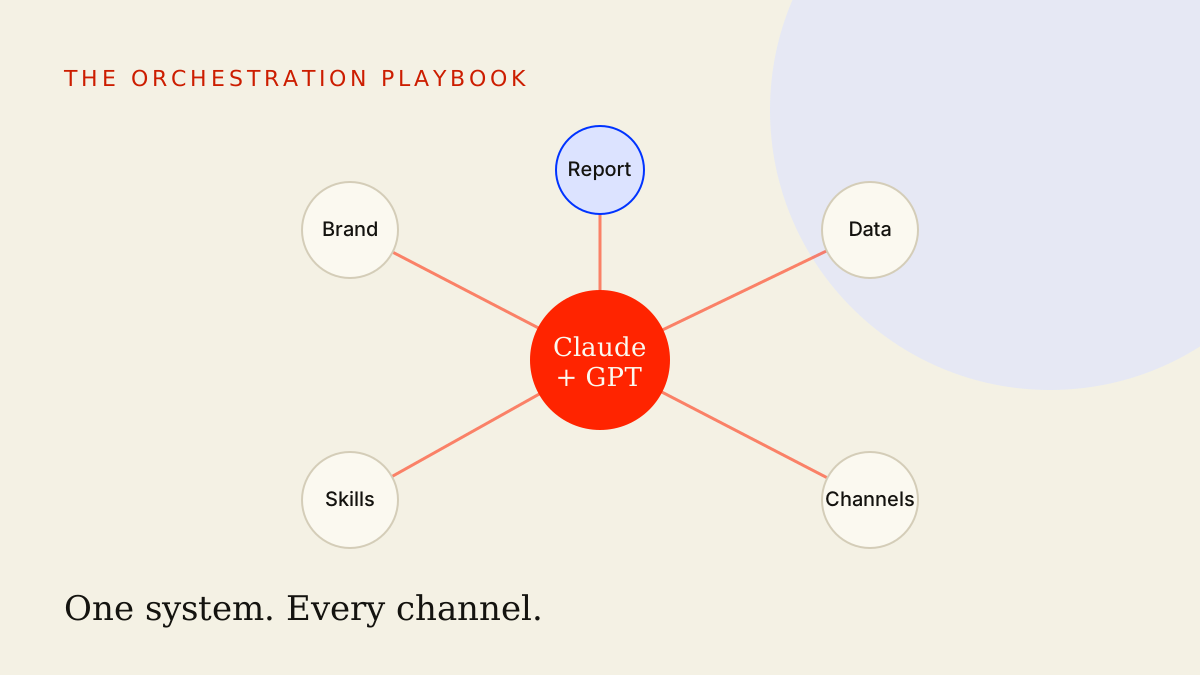
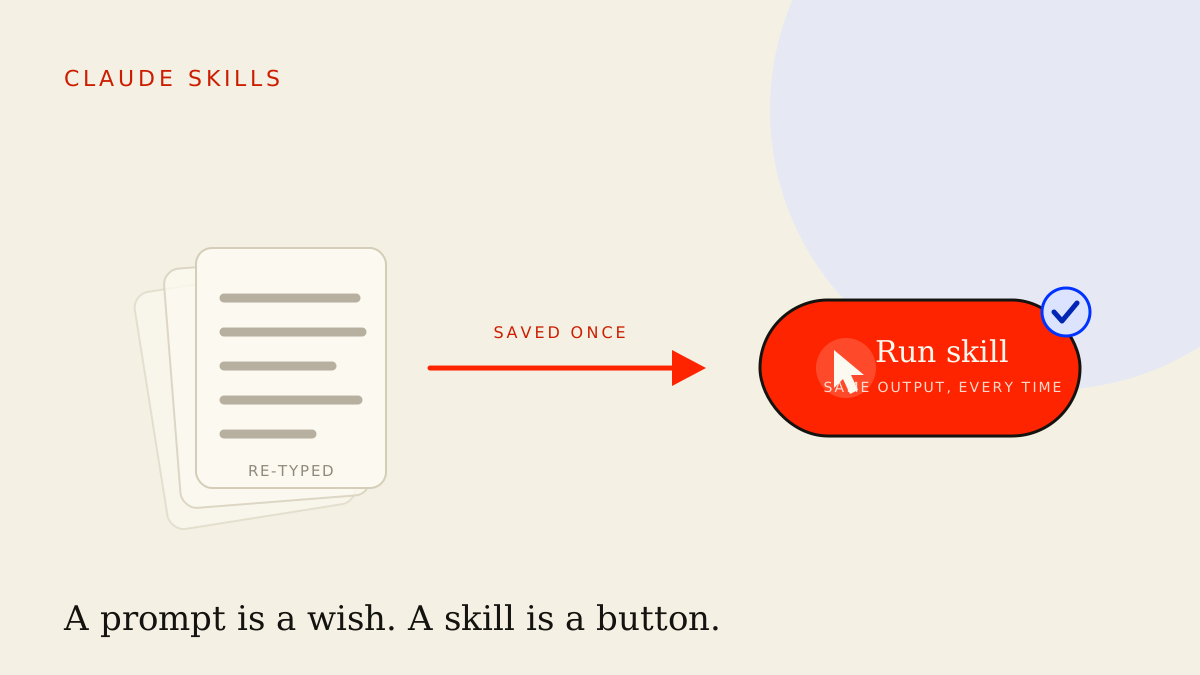
This is the progression every operator-built AI system follows: start with a brand brain so every agent shares a foundation, encode your repeatable moves as skills so each specialist runs its job the same way every time, then wire those roles into a coordinated pipeline. The multi-agent system sits on top of those — it assumes the brain and the skills already exist.
Run it that way and you stop being a freelancer with a clever assistant. You become the operator of a small, fast, repeatable agency — one that does each job well because no single mind is trying to do all of them at once.
Key takeaways
- A generalist assistant does every job adequately. Stacking research, strategy, writing, and editing into one context degrades all of them — that's the ceiling you feel.
- Run it like an agency. Specialised agents, each with one job, one brief, one output, all sharing the same brand brain.
- The orchestrator conducts, it doesn't play. It decomposes, routes, assembles, and gates — the moment it starts writing, you've lost the value.
- The critic is the gate. A separate editor in a fresh context, graded against a fixed rubric with no score without a quoted line, turns a draft into a reviewed draft.
- Don't over-engineer. Single-agent for single-step work; multi-agent only when the job has real hand-offs. Start with researcher, writer, critic — add roles to fix named problems.
The next step up from a clever assistant isn't a cleverer prompt — it's an org chart. Build the brand brain first in the orchestration playbook, encode your moves as skills in your first real workflow, then let your critic agent enforce the standard you set in the brand-voice system.
Frequently asked
- What is a multi-agent marketing system?
- It's a set of specialised AI agents — a researcher, a strategist, a copywriter, an editor, a distributor — each given one job and one brief, coordinated by an orchestrator that routes work between them. Instead of one chat doing everything adequately, each agent does one thing well, and the orchestrator assembles their outputs into a finished piece. It runs like a small agency rather than a single freelancer.
- When is multi-agent overkill versus worth it?
- It's overkill for single-step tasks — a tweet, a quick rewrite, a one-off summary — where the coordination costs more than it saves. It's worth it when the work has genuinely distinct stages that benefit from a fresh context and a different brief: research, then strategy, then drafting, then a critical review. The test is whether the job has hand-offs. If it doesn't, one good agent with a brand brain is enough.
- Do I need a team of engineers to run this?
- No. A lean operator runs a multi-agent system as a sequence of prompts with defined roles and hand-offs — the orchestrator can be a single prompt that delegates and assembles. You need clear thinking about who does what and what each agent receives, far more than you need infrastructure. The agency is in the design, not the headcount.
- What does the critic or editor agent actually do?
- It's a built-in QA gate. After the specialists produce a draft, the critic agent grades it against a fixed rubric — voice, factual support, brief coverage, structure — and either passes it or sends specific fixes back. Because it runs in a fresh context with one job, it catches what the writer is too close to see. It's the difference between a draft and a reviewed draft.
This is the thinking. The systems are the proof.
See how these ideas ship as working infrastructure.