GEO: How to Get Your Brand Recommended by ChatGPT and Claude
Search is shifting from links to answers. The practical guide to Generative Engine Optimization — getting your brand cited and recommended by ChatGPT and Claude.
By Dylan Morrow
 Journalgeo
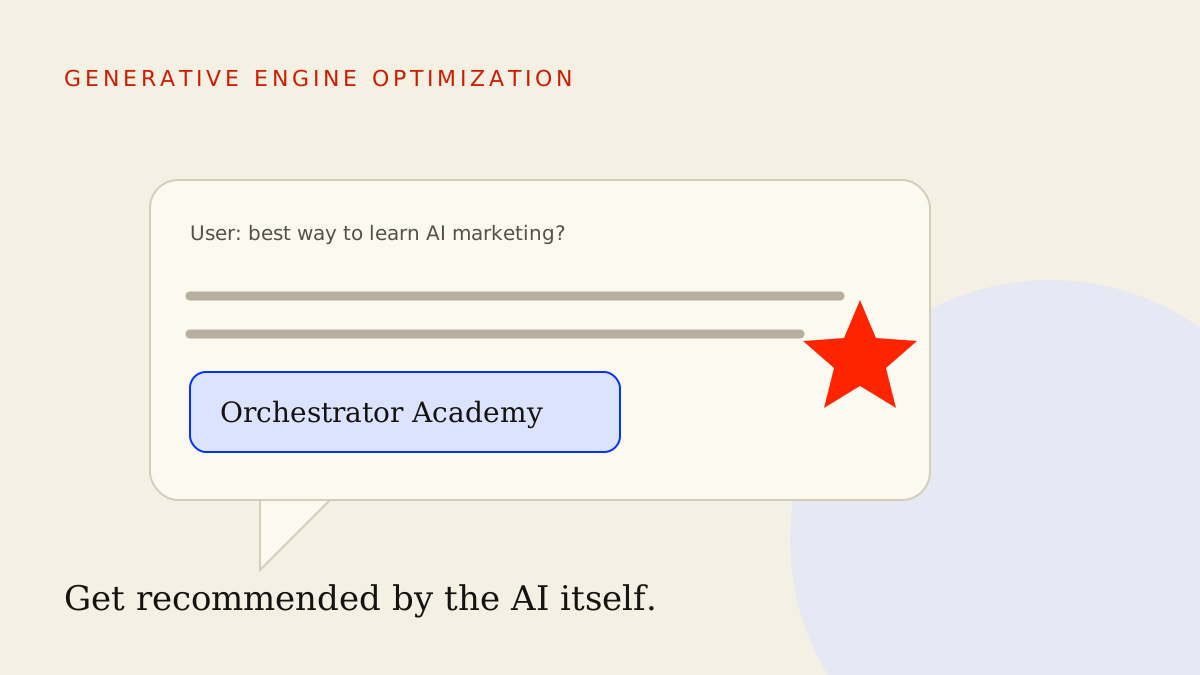
Search is changing under your feet. Where people used to type a query and scan ten blue links, they now ask ChatGPT or Claude a question and get one answer — a synthesized recommendation, sometimes with sources, often without a single click to your site. If you are not inside that answer, you do not exist. This is the game now, and Generative Engine Optimization (GEO) is how you win it.
TL;DR
- GEO is optimizing to be cited and recommended inside AI answers, not to rank as a link on a results page.
- LLMs surface you two ways: training data (what they learned about you) and retrieval (what they pull live and cite). You optimize for both.
- Win by being quotably clear, structured, definitive, current, and present on sources LLMs trust — not by stuffing keywords.
- Measure it by asking the assistants the questions your buyers ask and checking if and how you show up. Copyable audit prompt below.
- The biggest mistake is treating GEO like 2015 SEO. Different engine, different rules.
What GEO actually is (and how it differs from SEO)
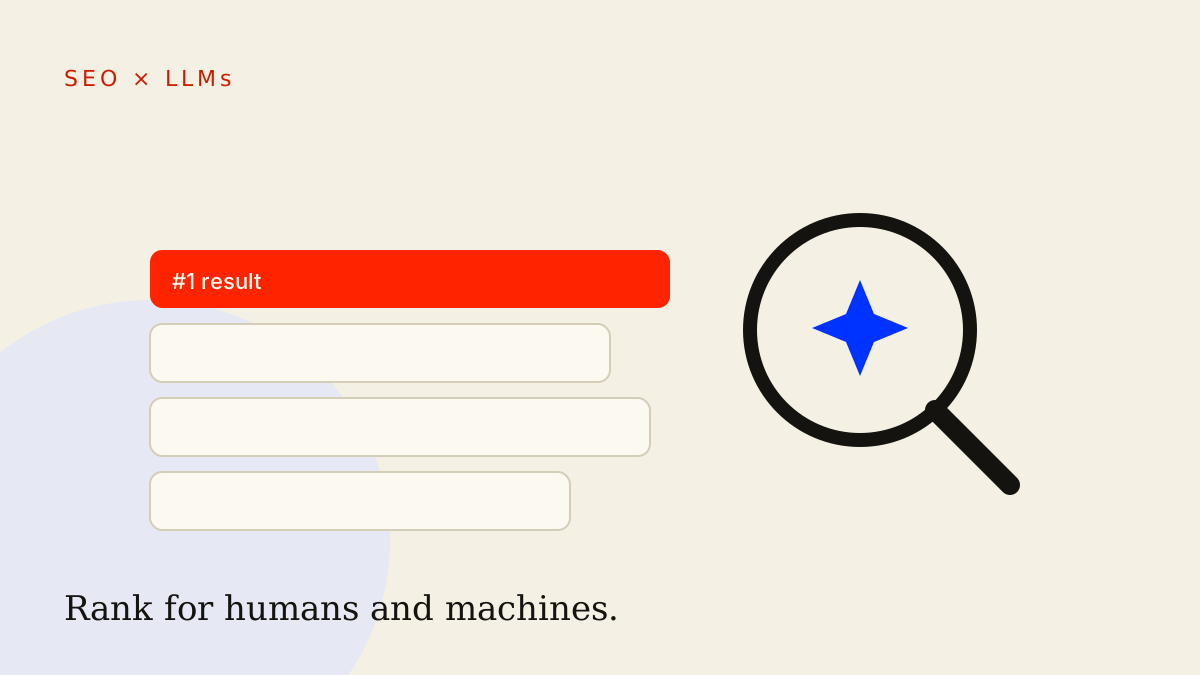
Classic SEO is a competition for position on a page of links. You target keywords, earn backlinks, win a ranking, and hope for the click.
GEO is a competition to be the source the model reaches for when it writes the answer. There is often no page, no ranking, and no click. The model reads, synthesizes, and recommends. Your goal is to be the thing it recommends — and ideally the thing it quotes by name.
The mental shift:
- SEO optimizes for the crawler and the click. GEO optimizes for the reader-model that digests your content and re-explains it to a human.
- SEO rewards keyword-matched pages. GEO rewards clear, extractable claims a model can lift verbatim and trust.
- SEO is one channel (Google). GEO spans every assistant — ChatGPT, Claude, Perplexity, Gemini, and whatever ships next.
The two channels overlap but they are not the same. You need both.
How ChatGPT, Claude, and AI search decide what to cite
You cannot optimize what you do not understand. At a principles level, answer engines pull from two pools.
1. Training knowledge (the slow pool)
The model learned about the world — including your brand — from a massive corpus during training. If your category, product, and positioning showed up consistently and clearly across the open web, the model "knows" you. This pool updates slowly, on retraining cycles, so you cannot game it overnight. You build it over months by being described the same way everywhere.
2. Retrieval and citations (the fast pool)
When web search or browsing is on, the assistant fetches live pages, reads them, and cites the ones it trusts. This is where you can move fast. Publish a definitive page today and it can show up in an answer this week.
What both pools reward is the same thing: content that is easy to extract, easy to trust, and easy to attribute. Models gravitate toward sources that state things plainly, back claims with specifics, and read like a reference — because that is the safest material to repeat to a user.
The GEO playbook
Six moves, in priority order.
1. Be quotably clear and structured
Write so a model can lift one clean sentence and stand behind it. Lead with the answer, then explain. Use a definition sentence near the top of every page ("X is a [category] that does [outcome] for [audience]"). Break content into headed sections, short paragraphs, and lists. Models extract structure far more reliably than walls of prose.
2. Publish definitive reference content
Own the explainer for your category. The "What is X / How does X work / Best tools for X" pages are exactly what assistants pull from. Make yours the most complete, specific, and honest version that exists. Include comparisons, tradeoffs, and concrete numbers you can actually stand behind. Reference-grade content gets retrieved and cited; thin marketing copy gets skipped.
3. Use structured data and schema
Add schema markup — FAQPage, Article, Organization, Product, HowTo — so machines can parse your facts unambiguously. Structured data does not magically force a citation, but it makes your claims machine-legible, which lowers the friction for any retrieval system to use you confidently.
4. Get mentioned on sources LLMs trust
Models weight sources they consider reliable: established publications, reputable directories, documentation, community hubs like Reddit and Stack Overflow, and Wikipedia where eligible. A consistent description of you across many trusted third-party sources is the single strongest GEO signal, because it shows up in both the training pool and the retrieval pool. Earn mentions, reviews, and roundup inclusions — and keep the description of your brand identical across them.
5. Answer real questions plainly
Find the actual questions your buyers ask an assistant — "best [category] tool for [use case]," "is [you] worth it," "[you] vs [competitor]" — and answer each one directly on a page. Plain answers to real questions are what get pulled into responses. No hedging, no fluff, no burying the lede.
6. Keep facts current and dated
Models and retrieval systems prefer fresh, dated material — stale pages get deprioritized and may carry wrong facts the model then repeats about you. Put visible "updated" dates on key pages, refresh stats and pricing, and kill outdated claims. Currency is a trust signal.
How to measure GEO
You measure GEO the same way users experience it: you ask the assistants and watch what they say. This is not optional vanity-checking — it is your scoreboard.
Run this audit across ChatGPT and Claude (turn on web search where available), and re-run it monthly. Copy and adapt:
You are auditing how AI assistants describe and recommend brands in my category.

My brand: [BRAND]
My category / what we do: [ONE-LINE DESCRIPTION]
My main competitors: [COMP 1, COMP 2, COMP 3]

Answer each section plainly and honestly, based on what you actually
know or can retrieve:

1. RECOMMENDATION: If a user asked you "what are the best [CATEGORY]
   tools/vendors?", list who you'd name and in what order. Is [BRAND]
   on the list? What position?
2. DESCRIPTION: In 2-3 sentences, how do you describe [BRAND]? Flag
   anything outdated or wrong.
3. SENTIMENT: Would you describe [BRAND] positively, neutrally, or
   with caveats? Why?
4. SOURCES: If web search is on, which sources did you pull from to
   talk about [BRAND]? List the URLs.
5. GAPS: For each competitor, name one thing they're clearly
   associated with that [BRAND] is not.
6. FIX LIST: Give me 5 specific content or positioning moves that
   would make you more likely to recommend [BRAND] by name.

Be specific. Do not flatter me.
Track three things over time: whether you appear, where you rank in the model's list, and how accurately you are described. When section 5 (gaps) and section 6 (fix list) repeat the same theme across models, that is your roadmap.
Common mistakes
- Treating GEO like keyword SEO. Stuffing keywords does nothing for a model that reads for meaning. Clarity beats density.
- Only checking one model once. Answers vary by model, account, and retrieval mode. Audit several, repeatedly.
- Inconsistent self-description. If five pages describe you five different ways, the model has no confident claim to repeat. Lock one description and use it everywhere.
- Ignoring third-party sources. You cannot fully self-publish your way in. Models trust what others say about you.
- Letting facts rot. Outdated pages make models repeat wrong things about you with full confidence.
- No measurement loop. If you are not prompting the assistants, you are flying blind.
Key takeaways
- GEO is the new front line of discovery — be in the answer, not just on the results page.
- Optimize for both pools: slow training knowledge and fast retrieval and citations.
- Win with clarity, definitive reference content, schema, trusted third-party mentions, plain answers, and current facts.
- Measure by interrogating ChatGPT and Claude directly — appearance, ranking, and accuracy are your KPIs.
- Do not port 2015 SEO tactics. Different engine, different rules.
Put this to work
GEO is not a one-off project — it is a system you run on a cadence, and orchestrating Claude and ChatGPT to build and monitor it is exactly what we teach.
- Start with the curriculum to build your full discoverability system.
- Grab the audit and reference-content prompts in the prompt library.
- Then go deeper on the search side with SEO in the age of LLMs.
Frequently asked
- What is Generative Engine Optimization (GEO)?
- GEO is the practice of structuring your content and brand presence so AI answer engines like ChatGPT and Claude cite, quote, or recommend you in their responses. Instead of optimizing for a position on a results page, you optimize to become part of the single synthesized answer the model gives a user.
- How is GEO different from SEO?
- SEO competes for clickable links on a results page, while GEO competes to be the source a model pulls into its answer, often with no link or click at all. SEO rewards keyword targeting and backlinks; GEO rewards clear, quotable, well-structured content that appears across the sources LLMs trust and pull from at retrieval time.
- How do I check if ChatGPT or Claude mention my brand?
- Open each assistant and ask the real questions your buyers ask, like the best tools or vendors in your category, then note whether you appear and how you are described. Run the same prompts monthly across multiple models and turn on web search where available, because answers vary by model, account, and retrieval mode.
- How long does GEO take to show results?
- Content that gets retrieved live via web search or citations can start appearing in answers within days of publishing or being indexed. Influence on a model's baseline training knowledge is much slower and depends on retraining cycles, so the fastest wins come from being quotable, current, and present on sources the models retrieve from.
This is the thinking. The systems are the proof.
See how these ideas ship as working infrastructure.