7 AI Prompts Every Marketer Should Steal (2026 Edition)
Seven copy-paste prompts for Claude and ChatGPT that handle voice audits, repurposing, campaign briefs, and reporting — with the reasoning behind each.
By Dylan Morrow
 Journalprompts
Most marketers use AI like a vending machine: type a vague request, get vague slop, paste it, regret it. The difference between slop and leverage isn't the model — it's the prompt. Below are seven prompts that turn Claude or ChatGPT into a real member of your marketing team.
TL;DR
- The model is only as good as the prompt. Specific inputs (voice samples, real metrics, audience details) beat clever wording every time.
- These seven cover the full loop: voice, repurposing, planning, research, hooks, reporting, and self-critique.
- Each one is copy-paste ready — swap the
[PLACEHOLDERS]and run. - Save them as templates. A prompt you reuse is a system; a prompt you retype is a chore.
- The last prompt is the most underrated: make the AI argue against your own draft.
1. The Brand Voice Audit
Use this before you let AI write a single sentence in your name. It reverse-engineers your voice from real samples so every future output sounds like you, not like a press release.
Paste in 3-5 of your best-performing pieces. The output becomes a reusable voice guide you can prepend to any other prompt.
You are a brand voice analyst. Below are [3-5] writing samples from our brand.

SAMPLES:
[PASTE YOUR BEST POSTS, EMAILS, OR PAGE COPY HERE]

Analyze them and produce a reusable voice guide with:
1. Tone in 5 adjectives, each with a one-line justification quoting the samples.
2. Sentence rhythm (length, fragments, punctuation habits).
3. Vocabulary: 10 words/phrases we clearly use, and 10 we'd never use.
4. How we open and how we close.
5. Three "do" rules and three "don't" rules for anyone writing as us.

Output as a clean style sheet I can paste into future prompts. Do not invent traits not supported by the samples.
2. The Multi-Channel Repurposer
Use this to turn one strong asset into a week of content. Stop writing each channel from scratch — write once, then adapt with constraints that respect each platform.
The trick is forcing the model to re-angle, not just resize. Add your voice guide from Prompt 1 on top for instant consistency.
Repurpose the asset below into platform-native content. Do not just shorten it — re-angle each version for how people actually consume that channel.

SOURCE ASSET:
[PASTE BLOG POST, THREAD, OR SCRIPT]

AUDIENCE: [WHO]
GOAL: [AWARENESS / SIGNUPS / ENGAGEMENT]

Produce:
1. One X/Twitter thread (5-7 posts, hook-first, no hashtags).
2. One LinkedIn post (story or insight angle, ~150 words).
3. Three short-form video hooks + a 3-bullet outline each.
4. One email (subject line + 120-word body + one CTA).
5. Two community/Discord-style posts written casually, not corporate.

Keep the core idea identical; change only the angle and format per channel.
3. The Campaign Brief Breakdown
Use this when you have a goal but no plan. Feed it a messy brief and it returns a sequenced pipeline you can actually assign and ship.
Great for translating a founder's "we need to launch the token" into discrete, ownable tasks with dependencies.
Act as a senior campaign strategist. Turn the brief below into an executable pipeline.

BRIEF:
[PASTE GOAL, AUDIENCE, BUDGET RANGE, TIMELINE, ANY CONSTRAINTS]

Return:
1. The single primary objective, stated as one measurable outcome.
2. Three to five workstreams (e.g., content, paid, partnerships, community).
3. For each workstream: the key deliverables, the owner role, and the rough sequence.
4. A week-by-week timeline as a simple table.
5. The top 3 risks and a one-line mitigation for each.
6. The 5 metrics we should track from day one.

Be concrete. If the brief is missing critical info, list your assumptions at the top before planning.
4. The Audience & Positioning Researcher
Use this when entering a new niche or sharpening a tired message. It pressure-tests who you're talking to and why they should care before you spend a dollar on creative.
Adapt it by pasting in a competitor's site copy and asking the model to find the white space they're ignoring.
You are a positioning strategist. Help me sharpen how we talk to a specific audience.

PRODUCT: [WHAT IT IS, IN ONE SENTENCE]
AUDIENCE: [WHO YOU THINK THE BUYER IS]
COMPETITORS / ALTERNATIVES: [LIST OR "what they do today instead"]

Deliver:
1. A sharper audience definition: their job-to-be-done, top 3 pains, top 3 desires.
2. The objections they'll raise before buying, ranked by likelihood.
3. Three positioning angles, each as a one-sentence promise + who it's NOT for.
4. The single message that would make them stop scrolling, and why.
5. Three questions I should validate with real customers before committing.

Flag anything that's a guess versus a defensible inference.
5. The Hook & Headline Machine
Use this whenever the first line decides whether anything else gets read. It generates variants across distinct psychological angles, not ten rewordings of the same idea.
Run it, pick the 2-3 strongest, then A/B test. Never ship the first headline you write.
Generate hooks/headlines for the content below. I want range, not repetition.

TOPIC: [WHAT IT'S ABOUT]
AUDIENCE: [WHO]
DESIRED EMOTION: [CURIOSITY / FOMO / RELIEF / STATUS]

Give me 12 options, grouped by angle:
- 3 curiosity-gap hooks
- 3 bold-claim / contrarian hooks
- 3 specific-number or result-driven hooks
- 3 "you" problem-callout hooks

Rules: under 12 words each, no clickbait we can't back up, no clichés ("game-changer", "unlock", "in today's world"). After the list, tell me which 3 you'd test first and why.
6. The Performance Report Builder
Use this to turn a wall of metrics into a story your boss or client actually reads. Paste raw numbers; get insight, not a data dump.
The value is in the "so what" — force the model to recommend actions, not just describe the chart.
You are a marketing analyst. Turn these metrics into a clear performance report.

PERIOD: [DATES]
GOALS WE SET: [e.g., 500 signups, 3% CTR]
METRICS:
[PASTE NUMBERS — channels, spend, clicks, conversions, anything you have]

Produce:
1. A 3-sentence executive summary: what happened and whether we hit goal.
2. What worked, what didn't, each tied to a specific number.
3. The most surprising insight in the data.
4. Three recommended actions for next period, ranked by expected impact.
5. One metric we should start tracking that we're currently missing.

Be honest about underperformance. Don't spin. If a number looks off or incomplete, say so.
7. The Skeptical Editor
Use this on every important draft before it ships. Most people ask AI to "improve" their writing, which just adds adjectives. Instead, tell it to attack the draft.
This is how you catch weak claims, buried leads, and bland phrasing — the stuff that makes copy forgettable.
You are a skeptical senior editor who has seen 10,000 marketing drafts and hates wasting readers' time. Critique the draft below. Do not rewrite it yet — interrogate it.

DRAFT:
[PASTE YOUR DRAFT]

Tell me:
1. The single weakest sentence and why it's weak.
2. Any claim that's vague, unsupported, or would make a smart reader roll their eyes.
3. Where I bury the most interesting idea — and where it should go instead.
4. Three phrases that sound like AI/corporate filler, with sharper replacements.
5. If a busy reader only read the first two lines, would they keep going? Yes/no and why.

End with a one-line verdict: ship it, revise it, or scrap it. Be blunt.
Key takeaways
- Specificity is the whole game. Paste real samples, real numbers, real audiences — vague in, vague out.
- Chain them. Voice audit feeds the repurposer; the brief breakdown feeds the report. Each output is the next prompt's input.
- Save every prompt as a template so your team runs the same playbook instead of reinventing it.
- Make the AI disagree with you. The skeptical-editor prompt prevents more bad copy than any "make it better" request ever will.
- You're the orchestrator, not the typist. Your job is direction and judgment; let the model do the volume.
These seven are a starting kit. For the full categorized stack we use across whole campaigns, grab the prompt library and see how it plugs into the curriculum and the skills hub.
And if you want every one of these prompts to sound unmistakably like you, start here: build your brand voice. Steal the prompts, keep the voice.
Frequently asked
- Do these prompts work in both ChatGPT and Claude?
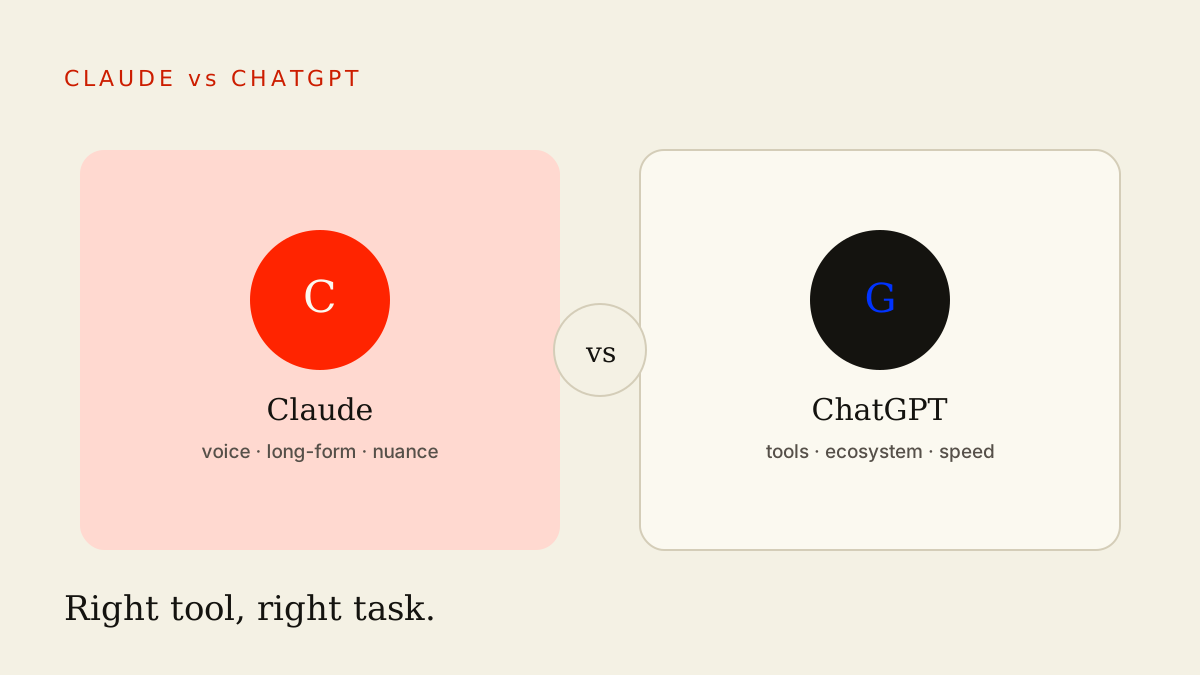
- Yes. Every prompt here is model-agnostic and written in plain instructions, so it runs in ChatGPT, Claude, or any capable LLM. Claude tends to hold voice and nuance better on long drafts, while ChatGPT is fast for high-volume variants, but the structure is identical across both.
- How do I adapt the placeholders without breaking the prompt?
- Replace anything in [BRACKETS] with your real details and delete brackets you do not need. Keep the surrounding instructions intact, because they are doing the heavy lifting. The more specific your inputs, the better the output, so paste real examples rather than vague descriptions.
- Should I save these as reusable templates?
- Absolutely. Store them in a prompt library, a notes app, or as saved custom instructions so you are not rewriting them every time. Treat each prompt as a reusable system, version it as you improve it, and your whole team can run the same playbook.
- Will AI-generated marketing copy sound generic if I use prompts like these?
- Only if you feed it generic inputs. These prompts force specificity by demanding your voice samples, real metrics, and an audience definition before they generate anything. The skeptical-editor prompt at the end exists precisely to strip out the bland, templated phrasing that makes AI copy obvious.
This is the thinking. The systems are the proof.
See how these ideas ship as working infrastructure.