SEO Is Not Dead: Content That Ranks in the Age of LLMs
LLMs changed search, they didn't end it. How to write content that ranks in Google and gets surfaced by AI assistants at the same time.
By Dylan Morrow
 Journalseo
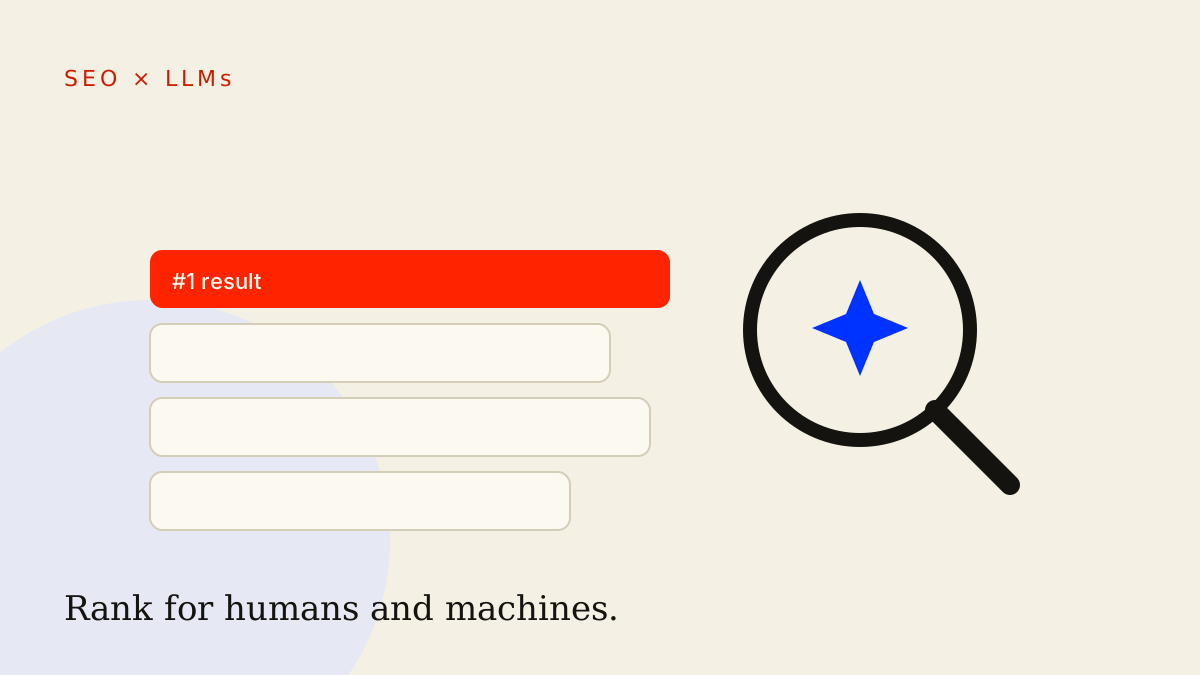
SEO isn't dead. It changed shape. You're no longer writing for one algorithm, you're writing for three audiences at once — a human skimming for an answer, Google's ranking systems, and an AI assistant deciding whether to quote you. Get that triangle right and a single page can rank, get clicked, AND get recommended inside ChatGPT and Claude.
TL;DR
- Search didn't shrink, it fragmented across Google, answer boxes, and AI assistants. Optimize for all three or lose share.
- The old fundamentals — intent, depth, structure, E-E-A-T — got more important, not less, because AI models lean on exactly those signals.
- Use the 5-part content framework below to write pages that rank in Google and get surfaced by AI.
- AI makes you faster, but raw AI output is thin-content fuel. The moat is first-hand experience and a real point of view.
- This connects directly to GEO (generative engine optimization) — same DNA, different surface.
How LLMs actually changed search behavior
Three shifts matter for marketers.
1. Zero-click went mainstream. A growing share of searches now end without a click — the answer shows up in an AI overview, a featured snippet, or a chatbot reply. Illustratively, a meaningful slice of informational queries (think in the range of "a large and rising minority") never send traffic to a website at all.
2. The query changed. People stopped typing best crm saas and started asking full sentences: "what's the best CRM for a 5-person agency that hates setup?" Conversational, intent-loaded, specific. Your content has to answer the real question behind the keyword, not the keyword.
3. A new gatekeeper appeared. When someone asks an AI assistant a question, the model assembles an answer from sources it trusts. If you're not in that trusted set, you're invisible in that conversation — even if you rank #1 on the old blue-link page.
The takeaway: you now compete for the answer, not just the ranking.
What still works (and works harder now)
Don't throw out your playbook. The boring fundamentals are the new edge.
- Search intent. Match the page to why someone is searching — informational, comparison, or ready-to-buy. AI models infer intent too; serve the wrong one and you get skipped by both.
- Depth over word count. Comprehensive, genuinely useful pages get cited because they answer follow-up questions before they're asked.
- E-E-A-T (Experience, Expertise, Authoritativeness, Trust). First-hand experience is the one thing AI can't fabricate. Real screenshots, real numbers from your own work, named authors with credentials — these are signals both Google and LLMs reward.
- Structure. Clear H2/H3 hierarchy, short paragraphs, descriptive subheads, and direct answers near the top. AI models parse structured pages far more reliably than walls of text.
The 5-part content framework that ranks AND gets surfaced
Use this on every money page. It's built so the same article satisfies Google's crawler and an AI assistant looking for a quotable, self-contained answer.
- Lead with the answer. In the first 2-3 sentences, directly answer the core question in plain language. This is what AI models extract and what wins featured snippets. Don't warm up — answer.
- Define the entities. State clearly what the thing is ("GEO is optimizing content to be cited inside AI answers"). Self-contained definitions get quoted because the model can lift them without context.
- Go deep with structure. Break the topic into scannable H2/H3 sections that each answer one specific sub-question. Use lists, steps, and comparison tables — formats AI loves to reuse.
- Prove experience. Insert at least one thing only you could write: a result you got, a mistake you made, a specific example from your own work. This is your E-E-A-T moat and your anti-commodity layer.
- Add a fact-dense FAQ. Close with 3-5 question-and-answer pairs written in full sentences. These map to long-tail conversational queries and are perfect bite-sized chunks for AI assistants to cite.
Run every draft through that checklist before publishing.
Use AI to do SEO faster — without producing thin content
AI is a force multiplier for the unglamorous parts of SEO: clustering keywords, outlining, drafting, finding gaps, generating FAQ candidates. The trap is shipping the draft. Generic in, generic out — and generic content is exactly what gets buried.
Here's a prompt to generate a real SEO content brief you can hand to a writer (or yourself):
You are an SEO content strategist. Build a content brief for an article
targeting the primary keyword: "[KEYWORD]".

Audience: [who they are + their level of awareness]
Search intent: [informational / comparison / transactional — pick one]
Business goal: [the action we want readers to take]

Deliver:
1. A working title + 2 alternates (each <60 characters).
2. The single search intent in one sentence — what the reader actually wants.
3. A self-contained 2-sentence "direct answer" to lead the article with.
4. An H2/H3 outline. Under each heading, note the specific sub-question it
   answers and any list/table/step format that fits.
5. 8-12 related questions real people ask (for FAQ + subheads).
6. 5 entities/terms to define clearly for AI extraction.
7. 3 prompts I should answer myself from first-hand experience — things AI
   can't know — so the page has genuine E-E-A-T.
8. Internal link suggestions and one clear CTA.

Be specific. No filler. Flag anything that requires a real human example.
The magic is point 7: the AI tells you where to inject the human expertise that makes the page un-commodity. That's the orchestration mindset — AI handles structure and speed, you supply the irreplaceable signal.
The line between helpful AI-assisted content and spam
Google's own guidance is clear: how content is made matters less than whether it's helpful and trustworthy. AI-assisted is fine. Mass-produced, unedited, no-added-value pages are not.
Stay on the right side of the line:
- Helpful: AI drafts the structure, a human adds experience, examples, and judgment. The page answers the question better than what already exists.
- Spam: Publishing dozens of near-identical AI pages at scale to chase keywords, with no original insight, no author, no experience. This is what "scaled content abuse" policies target.
A simple gut-check: if a reader can get a better answer from the AI directly than from your page, your page shouldn't exist. Your job is to be the source the AI wishes it had.
How this connects to GEO
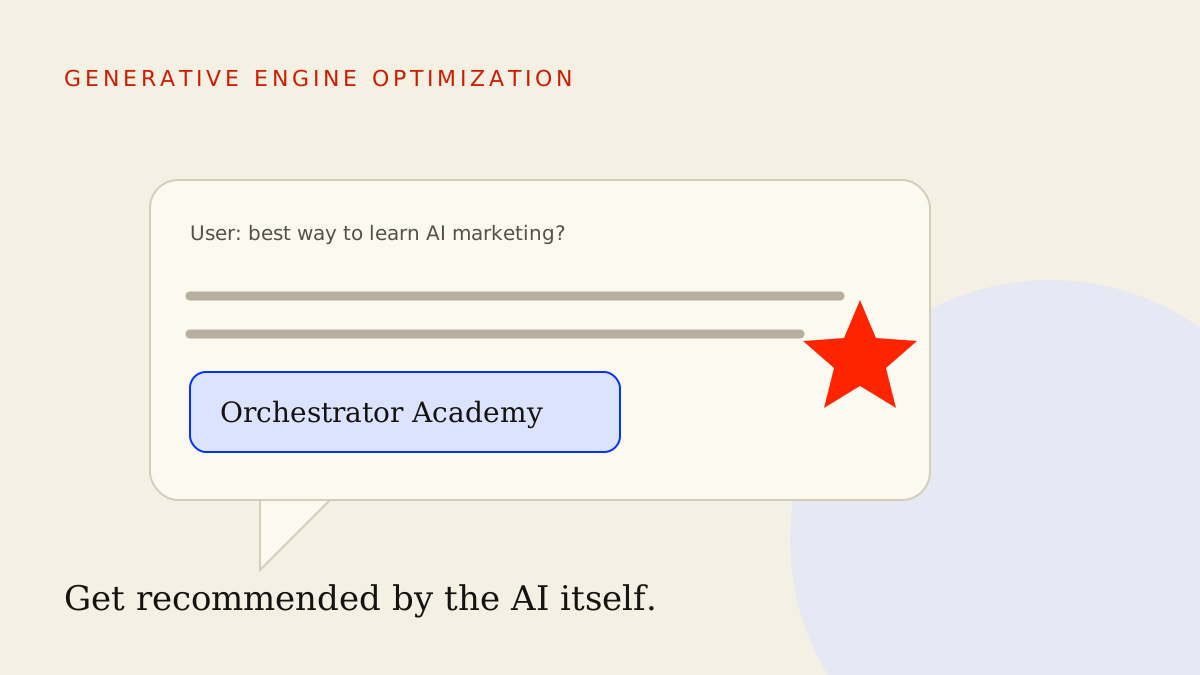
Everything here overlaps with generative engine optimization (GEO) — optimizing not just to rank, but to get cited and recommended inside AI answers. SEO and GEO share DNA: clarity, structure, authority, quotability. The difference is the surface. SEO targets the results page, GEO targets the answer itself.
If your goal is showing up inside ChatGPT and Claude responses, read the deep dive: GEO: get recommended by ChatGPT and Claude.
Key takeaways
- SEO evolved into a three-audience game: humans, Google, and AI assistants. Win all three with one well-structured page.
- The fundamentals (intent, depth, E-E-A-T, structure) are now the moat, because AI models reward exactly those signals.
- Apply the 5-part framework — answer first, define entities, structure deeply, prove experience, add a fact-dense FAQ.
- Use AI for speed, humans for experience. Raw AI output is thin-content fuel; first-hand insight is the edge.
- GEO is SEO's sibling — same principles, aimed at the AI answer instead of the ranking.
Ready to orchestrate your content engine?
You don't need more content. You need a system that turns AI speed into pages that rank and get cited. Start here:
- Get the step-by-step build inside the curriculum.
- Grab plug-and-play briefs and SEO prompts in the prompt library.
- Go deeper on getting surfaced by AI with GEO: get recommended by ChatGPT and Claude.
Frequently asked
- Is SEO dead now that people use ChatGPT instead of Google?
- No. Search demand didn't vanish, it split across Google, AI assistants, and answer boxes. The fundamentals that win in all three are the same: clear intent, real depth, and trustworthy authorship, so good SEO is more valuable now, not less.
- Can I just let AI write all my SEO content?
- You can use AI to draft, outline, and edit, but shipping raw unedited output is how you produce thin, generic pages that get ignored or penalized. The winning pattern is AI for speed plus a human for first-hand experience, specific examples, and a point of view that a model cannot invent.
- What is the difference between SEO and GEO?
- SEO optimizes to rank in search engine results pages, while GEO (generative engine optimization) optimizes to be cited and recommended inside AI assistant answers. They overlap heavily because both reward clarity, structure, and authority, but GEO puts extra weight on being quotable and factually self-contained.
- Do keywords still matter for content in 2026?
- Keywords still matter as a signal of intent and topic, but stuffing them is obsolete. Treat keywords as a map of the questions real people ask, then answer those questions completely and in plain language so both Google and AI models understand what your page is about.
This is the thinking. The systems are the proof.
See how these ideas ship as working infrastructure.