Claude vs ChatGPT for Marketing: When to Use Which
A practical, no-hype comparison of Claude and ChatGPT for marketing work — strengths, weaknesses, and a simple rule for picking the right one per task.
By Dylan Morrow
 Journalclaude
The real question was never "which AI is better." It's "which one do I reach for right now, for this task?" Treating Claude and ChatGPT as rivals is a beginner mistake. The operators getting the most out of AI treat them like two senior specialists on the same team — and they know exactly when to hand work to each.
TL;DR
- Both are excellent. The right choice is task-dependent, not brand loyalty.
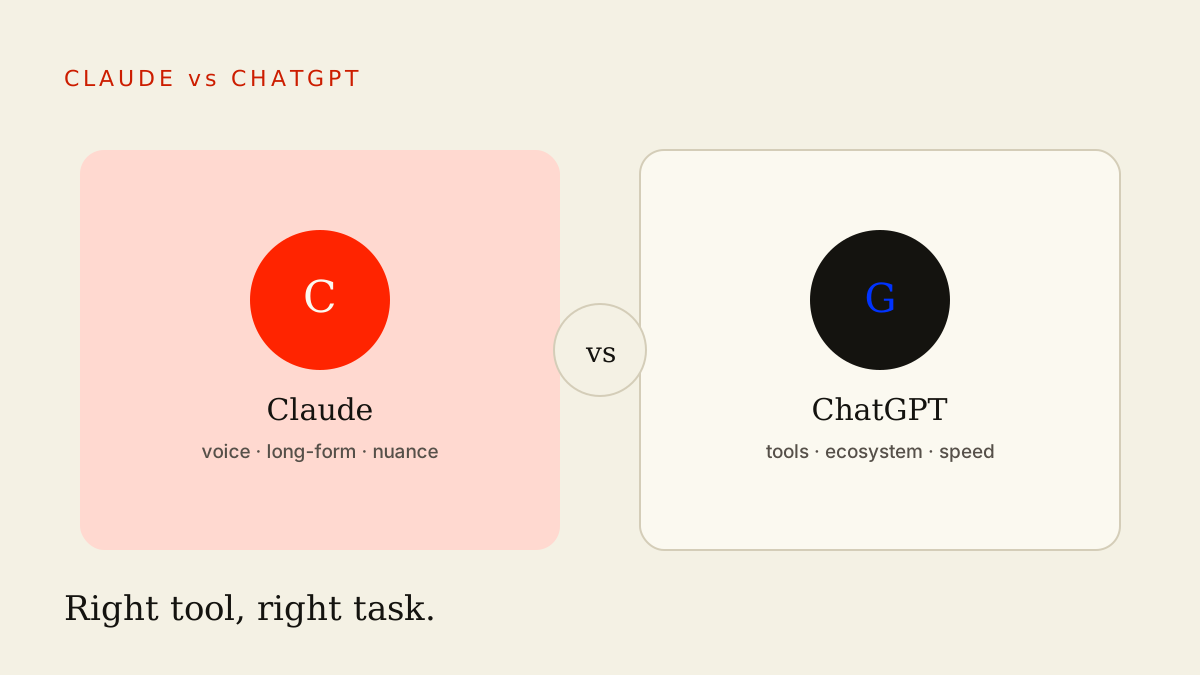
- Claude tends to shine at long-form writing, holding a nuanced brand voice, and following dense multi-step instructions across a long draft.
- ChatGPT tends to shine at fast research, multimodal work (images, voice, data), and its broad ecosystem of tools, integrations, and connectors.
- The pros use both — research in one, draft in the other, critique with the second.
- Default rule: reach for the tool whose core strength matches the output you need, then use the other as a second set of eyes.
Where each tends to shine for marketing work
Claude
For marketing teams, Claude is most often reached for when the writing itself is the product. Long-form blog posts, email sequences, landing-page copy, and pieces that need to hold a specific voice from the first line to the last tend to come out clean and on-brand.
Two things stand out in practice:
- Voice consistency over length. When you feed it a detailed brand brief and a few examples, it tends to keep that tone steady across a 1,500-word draft instead of drifting into generic "marketing-speak" halfway through.
- Following nuanced, layered instructions. If your brief has ten rules — never use these three words, always close with a question, keep sentences under 20 words — Claude tends to respect more of them at once without you babysitting every paragraph.
The trade-off: depending on your plan and setup, you may have fewer built-in extras like native image generation or a large gallery of third-party plugins. It's a writer's tool first.
ChatGPT
ChatGPT is most often reached for when you need more than text. Its strength for marketers is breadth — the ecosystem around it.
- Multimodal range. Generating images, working with voice, and reasoning over screenshots, charts, and uploaded files all live in one place. For social content and quick visual concepts, that matters.
- Research and synthesis. It's a strong first stop for "go find and summarize" tasks — competitor scans, pulling themes from a messy doc, turning a transcript into structured notes.
- Tools, plugins, and integrations. A wider catalog of connectors and custom configurations means it slots into more existing stacks with less friction.
The trade-off: many marketers find that for sustained long-form copy, output can need a heavier editing pass to stay on-voice. Excellent at versatility; sometimes less surgical on tone.
A fair caveat: both tools update constantly, and a gap you notice today may close next quarter. Test on your work rather than trusting any single comparison — including this one.
Side-by-side: which to lean toward, by task
| Marketing task | Lean toward | Why |
|---|---|---|
| Long-form blog / article drafting | Claude | Holds voice and structure across length |
| Brand-voice email sequences | Claude | Follows layered tone rules consistently |
| Competitor / market research | ChatGPT | Strong synthesis and fast first-pass scans |
| Image + social visual concepts | ChatGPT | Native multimodal generation |
| Repurposing a transcript into assets | Either | Both handle this well; pick by output format |
| Editing / critiquing existing copy | Either | Use whichever didn't write the draft |
| Pulling structure from messy docs | ChatGPT | Reasons over uploaded files and data |
| Nuanced rewrite to a strict style guide | Claude | Respects dense instruction sets |
| Connecting into an existing tool stack | ChatGPT | Broader integration ecosystem |
"Lean toward" is the operative phrase. None of these are walls — they're tendencies many marketers report. Your prompt quality moves the needle far more than the logo.
How to actually use both together
The highest-leverage move is a relay, not a duel. Pass the work down a short assembly line and let each tool do the part it's best at.
A workflow that holds up across most content jobs:
- Research in ChatGPT. Scan competitors, pull themes, summarize a transcript or source doc into a clean brief.
- Draft in Claude. Feed it that brief plus your brand voice rules and ask for the long-form piece.
- Critique with the other tool. Paste the draft into ChatGPT and ask it to poke holes — weak hook, vague claims, off-voice lines. A model critiquing output it didn't write tends to catch more than one grading its own homework.
- Final polish in your strong-voice tool. Take the critique back to Claude for a tightening pass.
This cross-checking step is where the real quality jump happens. Two specialists reviewing each other beats one doing everything.
A simple decision rule
When you're unsure, run this in your head:
- Is the deliverable mostly words that must sound like your brand? → Start in Claude.
- Do you need research, images, data, or an integration? → Start in ChatGPT.
- Important enough to get wrong? → Draft in one, critique in the other.
That's it. Don't overthink the first pick — overthink the handoff.
A prompt that works in either tool
This one runs cleanly in Claude or ChatGPT. Use it to pressure-test any draft before it ships — ideally in the tool that didn't write it.
You are a skeptical senior content editor reviewing a marketing draft before publication.

Brand voice: [paste 2-3 sentences describing your voice + 1 example sentence]
Audience: [who this is for]
Goal of the piece: [the one action or belief you want]

Here is the draft:
"""
[paste draft]
"""

Do four things, in this order:
1. Rate the hook (first 2 sentences) 1-10 and rewrite it stronger.
2. Flag every sentence that drifts off the brand voice above. Quote it, then give a fix.
3. List any claims that sound vague, generic, or unverifiable.
4. Give me the 3 highest-impact edits, ranked. No fluff.
Swap the bracketed parts, paste your draft, and you have an instant editor. Run the same prompt in both tools on an important piece and merge the best notes.
Key takeaways
- It's not a winner — it's a roster. Claude and ChatGPT are both strong; pick per task.
- Match the tool to the output: words-and-voice tend to favor Claude; research, multimodal, and integrations tend to favor ChatGPT.
- The relay beats the duel. Research, draft, then critique with the opposite tool.
- Your prompt and reference material matter more than which model you opened.
- Test on your own work. These are tendencies, and both tools change fast.
Put this into practice
Knowing when to reach for each tool is step one. Building it into a repeatable system is the real skill — and that's what we teach.
- Start with the curriculum to build your orchestration foundation.
- Grab proven prompts from the prompt library so you're not starting from a blank box.
- Go deeper on combining tools into one machine with the orchestration playbook.
Frequently asked
- Is Claude or ChatGPT better for marketing?
- Neither is universally better — they are both excellent, and the right pick is task-dependent. Many marketers lean on Claude for long-form writing and nuanced brand voice, and on ChatGPT for research, multimodal work, and its broad ecosystem of tools and integrations.
- Can I use Claude and ChatGPT together in one workflow?
- Yes, and most serious operators do. A common pattern is to research and brainstorm in one tool, draft in the other, then cross-check the output by pasting it into the second tool for a critique pass.
- Which tool is better at following detailed brand guidelines?
- Both can follow detailed instructions well when you give them a clear brief and examples. Many marketers find Claude tends to hold a nuanced tone and a long set of rules across a draft, but results depend far more on your prompt and reference material than on the tool itself.
- Do I need to pay for both tools?
- Not necessarily. Start with the one that fits your most frequent task, and add the second only when you hit a real limitation — such as needing stronger research, image work, or a specific integration the other handles better.
This is the thinking. The systems are the proof.
See how these ideas ship as working infrastructure.